.svg)
Individuality
·
Leadership
Reinvention Requires A Village — Why You Can't Do This Alone
There's a persistent myth about reinvention: that it's a solitary act of will. You decide to change. You do the internal work. You emerge transformed.
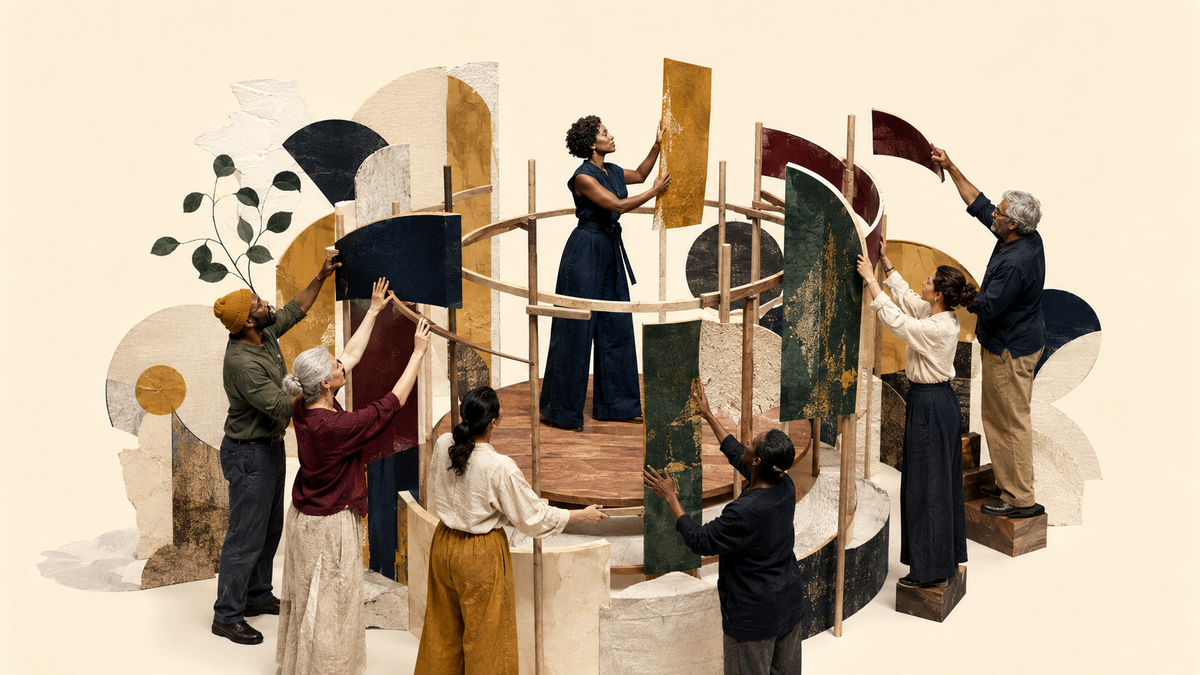
This is not how it works.
Bill Hulseman taught world religions and served as a campus minister for decades while keeping a fundamental part of himself hidden, a part he believed he had good reasons to conceal. He thought his presence in that environment was itself a form of protection for young people who might be questioning their identities. He was providing a safe space.
Then, at a conference, Dan Savage challenged an audience of educators with advice Bill had never considered: if you're hiding who you are from your students, the message you're sending isn't safety. It's that it's acceptable to leave part of yourself at the door.
"I had never thought of it that way," Bill told me later.
That single perspective, from one person, at one moment, changed the entire trajectory of his professional life. He eventually moved out of that environment and into work that aligned fully with who he was. Today he designs rituals, helping couples build customized ceremonies rooted in their identities. He is, by his own description, fully himself.
The spark for his transformation came from someone else.
This is not unusual. It's the rule. In my decades of studying and supporting professional reinvention, I've rarely seen someone navigate genuine transformation in isolation. The process almost always involves at least one person who challenged a comfortable assumption, one person who offered support when the path got difficult and one person who modeled what was possible.
Ray Anderson, the founder of Interface, had his perspective shattered by a question from an audience member and then rebuilt it through Paul Hawken's book, someone else's knowledge, freely shared. His commitment to that vision was cemented by a colleague named Glenn Thomas, who sent Ray an original poem after hearing Ray's new direction, letting him know that one person, at least, truly got it.
Three people made Ray's reinvention possible: the questioner, the author and the colleague who offered unsolicited encouragement at exactly the right moment.
Who are those people in your reinvention?
The research is clear that perceived social support, simply believing that support will be available if you need it, significantly reduces the stress of navigating difficult transitions. In studies of ambulance personnel facing organizational stressors, perceived support had a bigger impact on coping ability than support actually received. Knowing someone has your back changes the way you approach risk.
This is why the professionals who successfully reinvent themselves almost always invest in relationships before they need them. Not transactionally, not as networking in the calculating sense, but genuinely. They build cultures of belonging. They show up consistently for others. They make deposits long before they need to make withdrawals.
If you're planning a significant reinvention, the internal work is necessary. It's not sufficient. The question isn't only what you need to change inside yourself. It's also: Who are the people without whom this reinvention cannot happen?
Go find them.
Reinvention requires a village. Invest in relationships long before you need them.
© 2026 Glenn Llopis. All rights reserved.
This article is the original work of Glenn Llopis and is protected by copyright. It may not be republished, reproduced, distributed or adapted, in whole or in part, in print, online or by AI tools, without prior written consent. You are welcome to share the link or quote a brief excerpt with credit to Glenn Llopis and a link back to this page. For permission requests, contact solutions@glennllopisgroup.com.
Get the next essay in your inbox
New essays on leadership, identity and conviction, sent to you when they publish. Free, and you can unsubscribe anytime.
Thank you. You're subscribed to Conviction Chronicles.
Something went wrong. Please try again.




.svg)
.svg)
.svg)
.svg)
.svg)
.svg)
