.svg)
Glenn Llopis has been building one methodology for two decades, and each part of it was introduced in a book. This page defines every term and says where it came from.
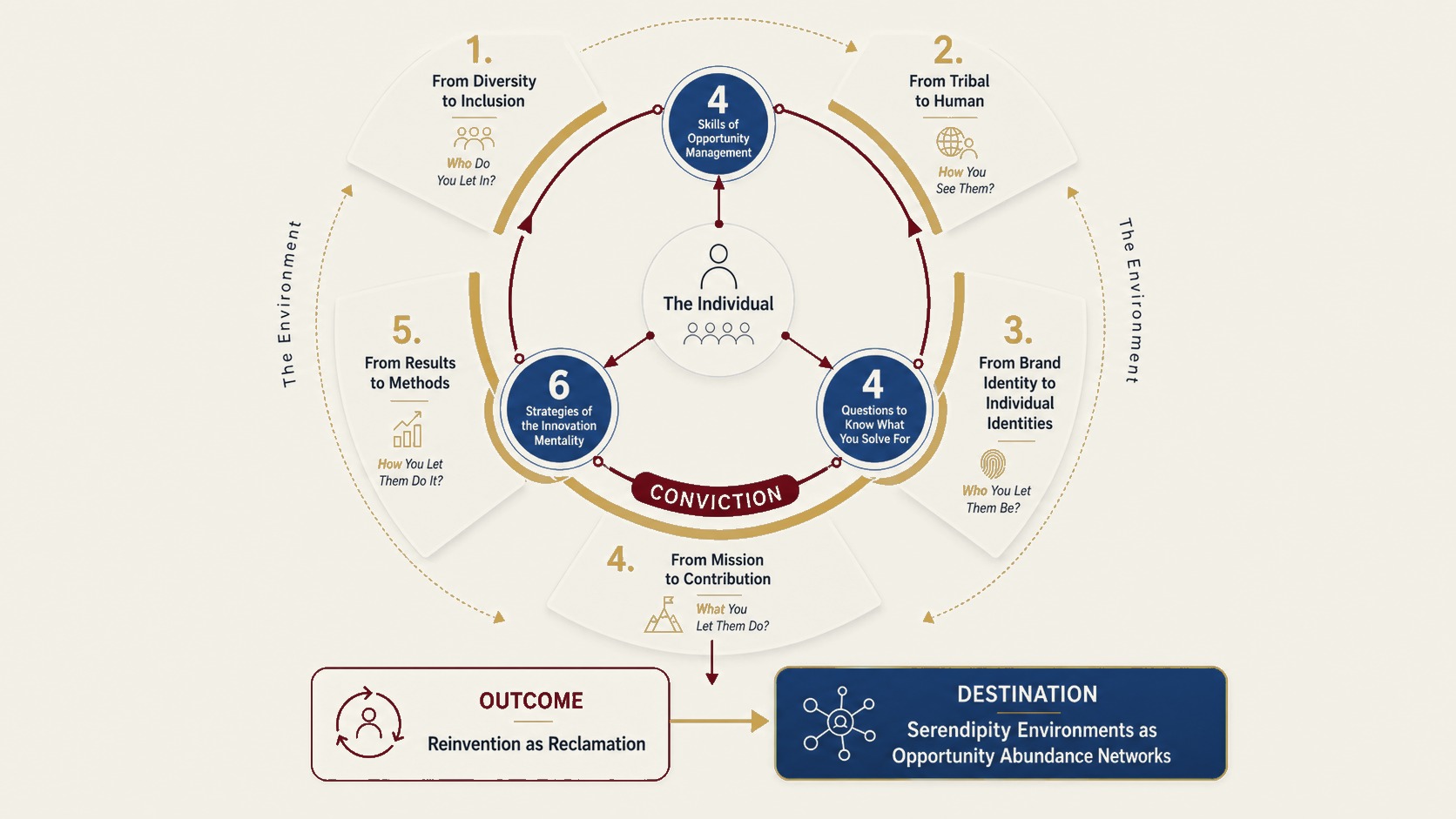
The methodology in one view. Every term below is defined, with the book it came from.
See, Sow, Grow and Share: how a person creates opportunity rather than waiting for it. Glenn Llopis introduced them in Earning Serendipity (2009).
What is your Enduring Idea? Your Primary Differentiator? Your Primary Experience? What do you solve for? Glenn Llopis devoted a chapter of The Innovation Mentality (2017) to these four questions, which together define a leader’s personal brand.
The inspiration to see opportunity in everything, the flexibility to anticipate the unexpected, the freedom to unleash passionate pursuits, the room to live with an entrepreneurial spirit, the trust to work with a generous purpose, and the respect to lead to leave a legacy. Glenn Llopis introduced them in The Innovation Mentality (2017). Each names something the environment must provide and what the individual does with it.
What Glenn Llopis calls the condition of a capable leader who has spent years performing confidence and quietly lost the conviction underneath it. Nothing visible breaks; the leader simply stops trusting their own read of a situation and waits for consensus, data or permission before moving.
Who You Are, How You Grow, How You Lead, What You Create, and Leading With Conviction. Glenn Llopis structured Earning Conviction (2026) around these five, on the principle that conviction is not earned through reading but through practice.
The five changes that move an environment from standardization to personalization, so it works for individuals rather than for a standard everyone is measured against: from diversity to inclusion, from tribal to human, from brand identity to individual identities, from mission to contribution, and from results to methods. Glenn Llopis set them out in Leadership in the Age of Personalization (2019).
The question beneath each shift, which is how a leader reads where their environment actually sits: Who do you let in? How do you see them? Who do you let them be? What do you let them do? How do you let them do it? Glenn Llopis introduced the indicators in Unleashing Individuality (2022). They measure behavior, so the goal is not to abandon standardization but to find the right balance within each shift.
The parts of themselves people learn to leave out in order to fit the room. Glenn Llopis uses the term to describe a process that usually begins around fifteen and is still being paid for at forty-five.
Most people reinvent when something forces them to, and call the result growth. Glenn Llopis calls the alternative reinvention on purpose: changing because you decided to, from a position you own, which is possible only when you are certain enough of who you are to move before the situation demands it.
The rooms and networks where opportunity becomes abundant because people are known well enough to be connected to it. Glenn Llopis introduced the idea in Earning Serendipity (2009) and has developed it since into the destination of the method: what you become able to recognize, and then to build for others.
The methodology itself: leadership built on the individual rather than the standard everyone is measured against, on the premise that organizations designed to standardize people forfeit the contribution they most need. Glenn Llopis introduced it in Leadership in the Age of Personalization (2019) and has developed it since through the executive summit series he has designed and hosted since that year.
Glenn Llopis’s description of his own role. A catalyst adds nothing foreign; it accelerates a change the material was always capable of. Standardization homogenizes, making things uniform and interchangeable. A catalyst does the opposite: it activates what is uniquely present in the material, accelerating a reaction only that material could produce. Catalysis is, by nature, anti-standardization. To catalyze is to personalize. The work is not to hand a leader a new self but to create the conditions for the real one to surface, and to turn it into conviction they can lead from.
The three entry points to the same method. Claim is for young people who have not yet been edited much. Reclaim is for adults recovering what they buried. Transform is for the institutions that taught both of them to edit. Most people need more than one door: one for themselves, one for the team they lead, one for the child at home.
The individual and the environment together produce an identity you actually know. That identity carries the conviction to reinvent on purpose, because you know how to create opportunity with abundance rather than wait for it. And that is what lets you recognize, with confidence, the environments you were made for, and with agency, shape them for the people you lead.
Take the Conviction Diagnostic. In three minutes, see where you've traded who you are for who the room wanted, and exactly where to begin reclaiming it.

His story starts where reinvention did: a family that left everything behind for a new country and refused to call it loss. Cuban Roots →
.svg)
.svg)
.svg)
.svg)
.svg)
.svg)
