.svg)
Leadership in the Age of Personalization® was written for adults inside institutions. This is the same architecture in a teenager’s language, across three acts and six books, delivered through Teens UnEdited™.
Not a simplification. A translation. The four skills of opportunity management become four ways to make your own breaks. The six strategies of the Innovation Mentality become six moves for thinking different. The five shifts become five ways to stop being a copy. The five indicators become the five questions that read a room. Reinvention stays reinvention. Conviction becomes the record you build by choosing what you mean, again.
Three acts, six books, one journey. Each act is a pair of books that complete each other, and the acts run in order: first you learn that you can act, then you learn to act as yourself, then you learn to keep doing both as you change.
One thread runs underneath all three. Conviction is never announced. It is built silently across Acts One and Two, named as the constant in Act Three, and revealed only at the end, in the moment a reader realizes the six books were never separate.
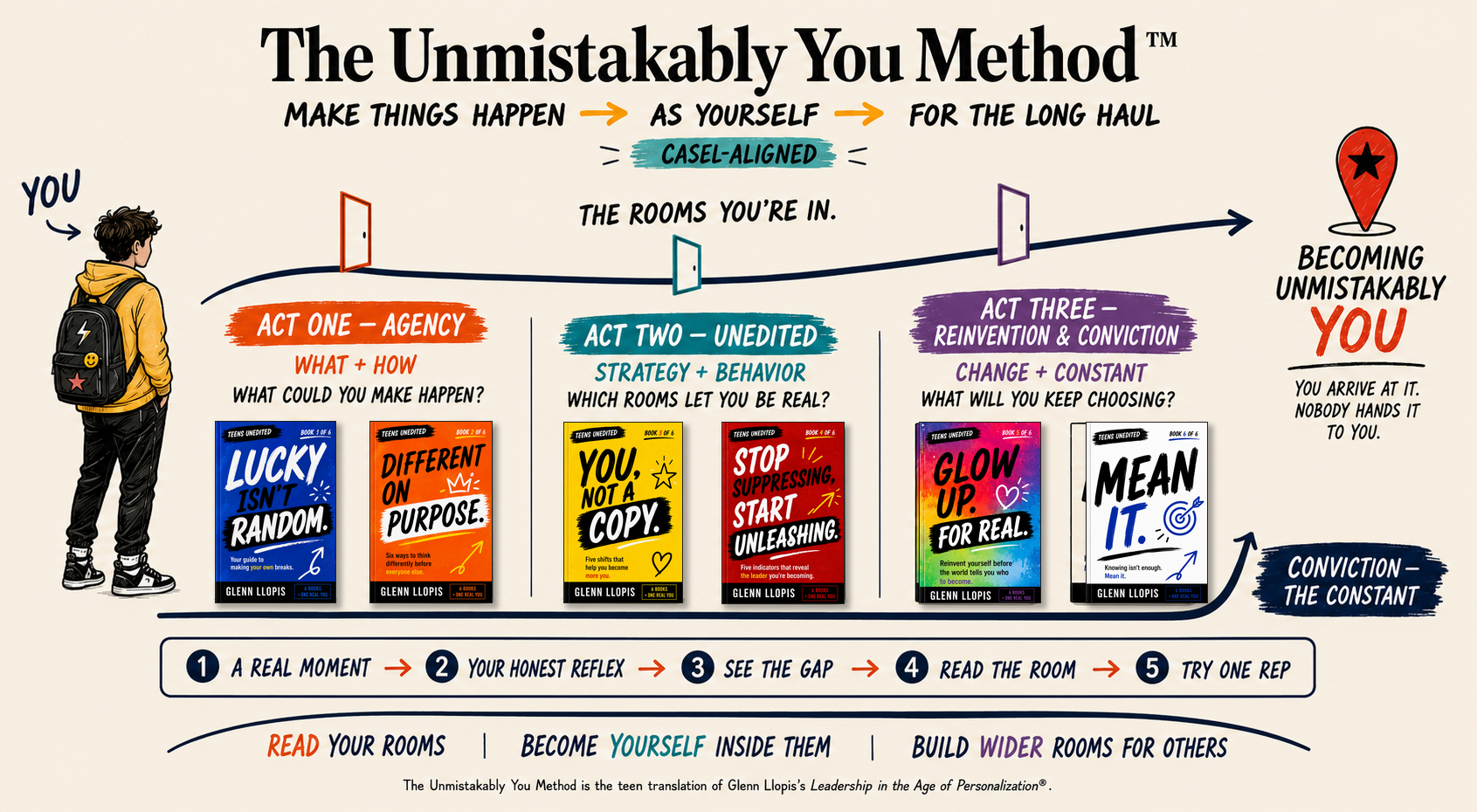
What and how. Learn that you can make things happen. The question the act asks: what could you make happen?

Every school has a kid who seems to get all the breaks, and everyone else has quietly decided they were born lucky. Luck is not a lottery. It is a set of moves, run by someone who never announced them. See Wider trains attention. Start Small, Start Now kills the wait for readiness. Grow What’s Working feeds what shows signs of life and cuts what does not. Share the Win keeps it circulating, and stops working the moment you keep score. See, sow, grow, share.
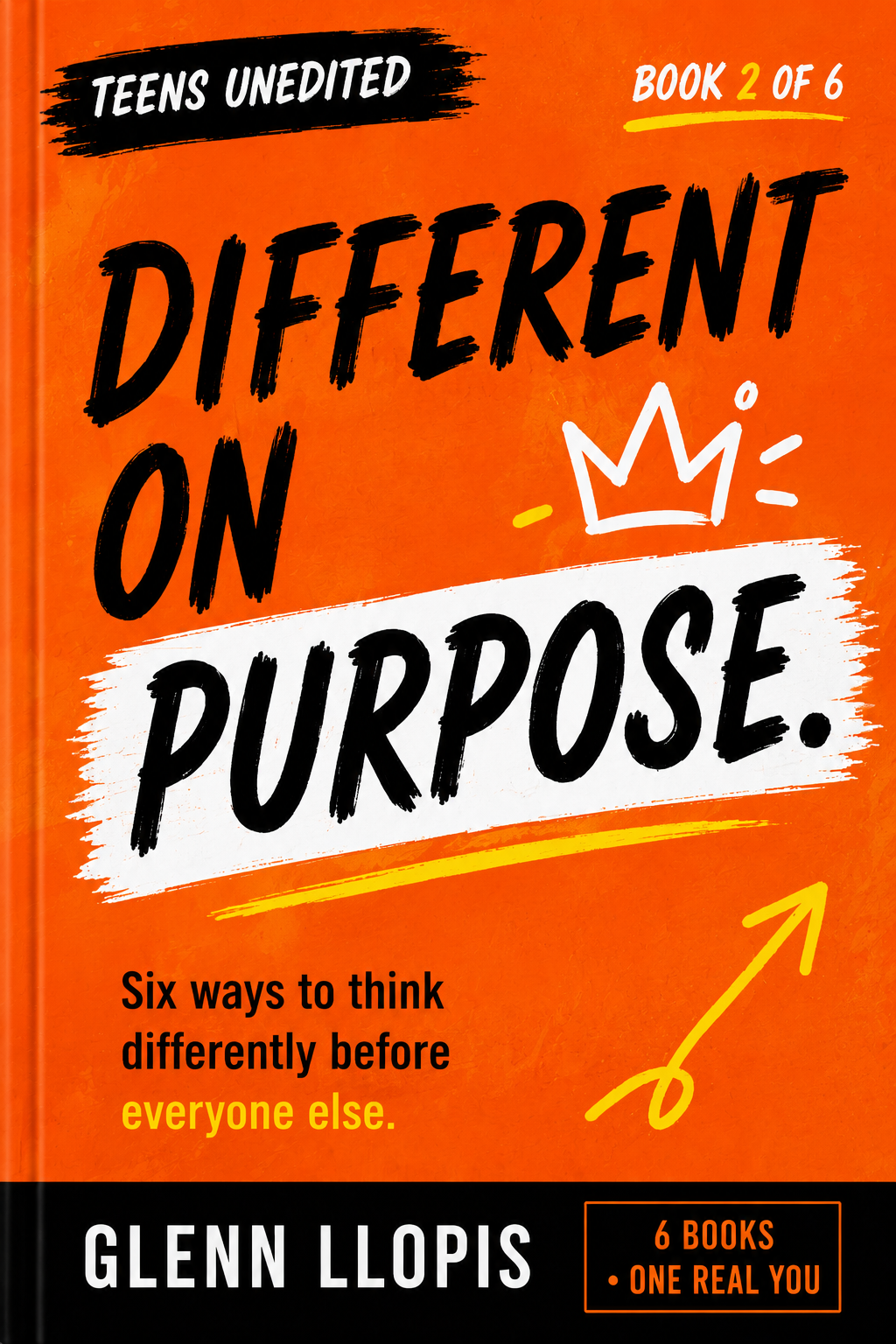
It opens in a room full of same answers, including the kid who had a better one and swallowed it. That swallowed answer is the asset. This is not about being contrarian. Being different for its own sake is just a louder way of performing for the room. It is about thinking at a slant on purpose and having the nerve to say the result out loud. It closes with four questions that are a teenager’s first real pass at a personal brand, asked without the word.
Strategy and behavior. Learn to be yourself in the rooms you are in. The question the act asks: which rooms let you be real?

This names the thing every teenager feels and cannot articulate: the template. School has to design for the middle, which is arithmetic rather than malice, and the further a teenager sits from average in any direction, the more they mistake a bad fit for a personal defect. The sentence that reframes everything after it arrives early. When there is a gap between how you have been measured and what you are capable of, ask what is wrong with the room before you ask what is wrong with you. Not instead of. Before.
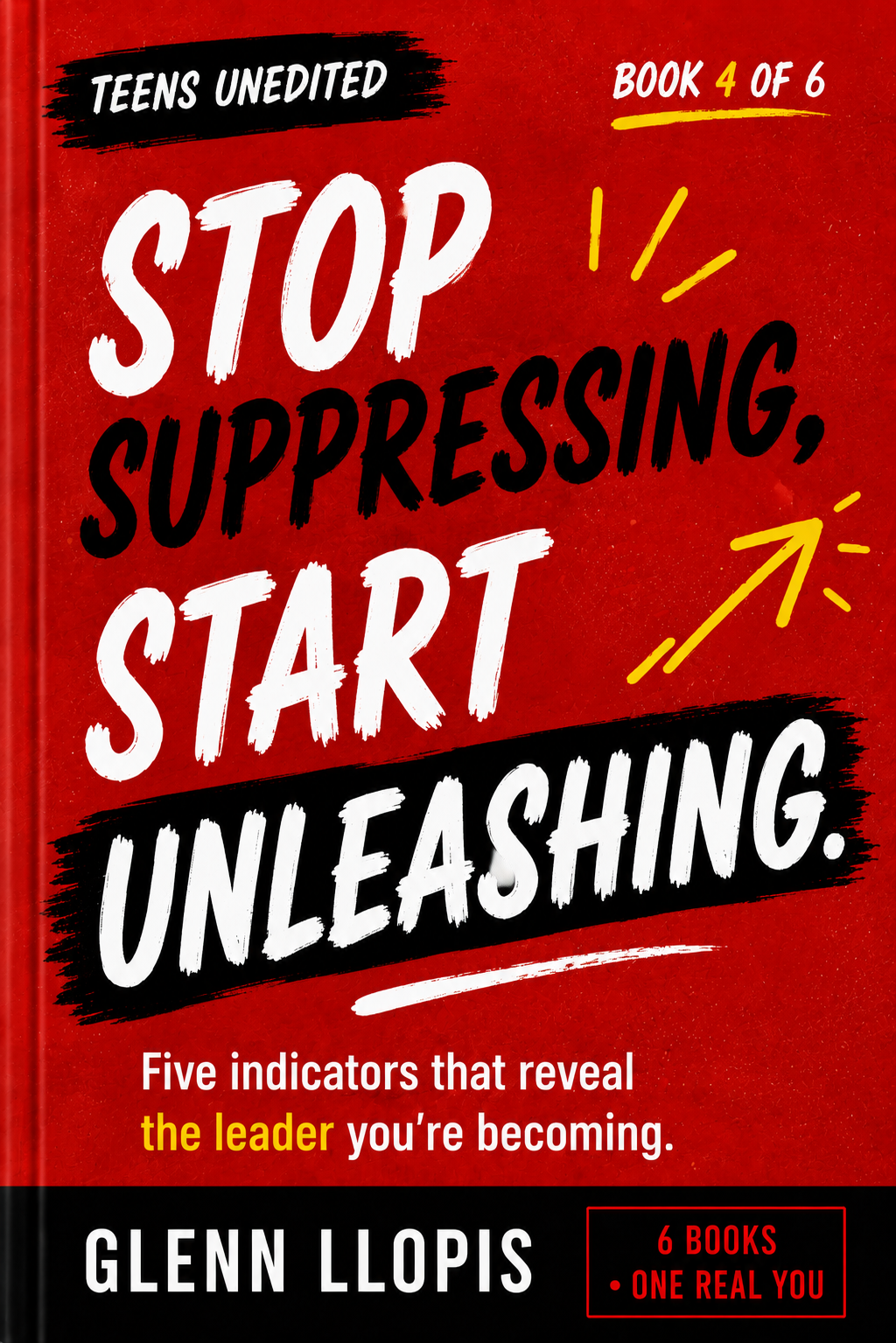
Book 3 changes the person. This one reads the room, and the pair only works together. A teenager can run all five shifts perfectly and still land somewhere that only ever wanted them fitting in. Five questions, short enough to ask in a doorway. Am I actually in? Do they see me, or a label? Can I be myself here? Do I get to do anything real? Do I get to do it my way?
Change and constant. Learn to keep becoming yourself over time. The question the act asks: what will you keep choosing?

Teenagers are handed the phrase and taught to mean a haircut. This means changing on purpose, in public, without apologizing, and doing it as a skill rather than waiting for a crisis to force it. Its central problem is one almost every teenager runs into and almost no adult names: the people around you have an investment in the version of you they already know, so growing out of it feels like a betrayal. Six skills run on one engine. Learn, unlearn, relearn, repeat. The unlearning is the step nobody teaches.
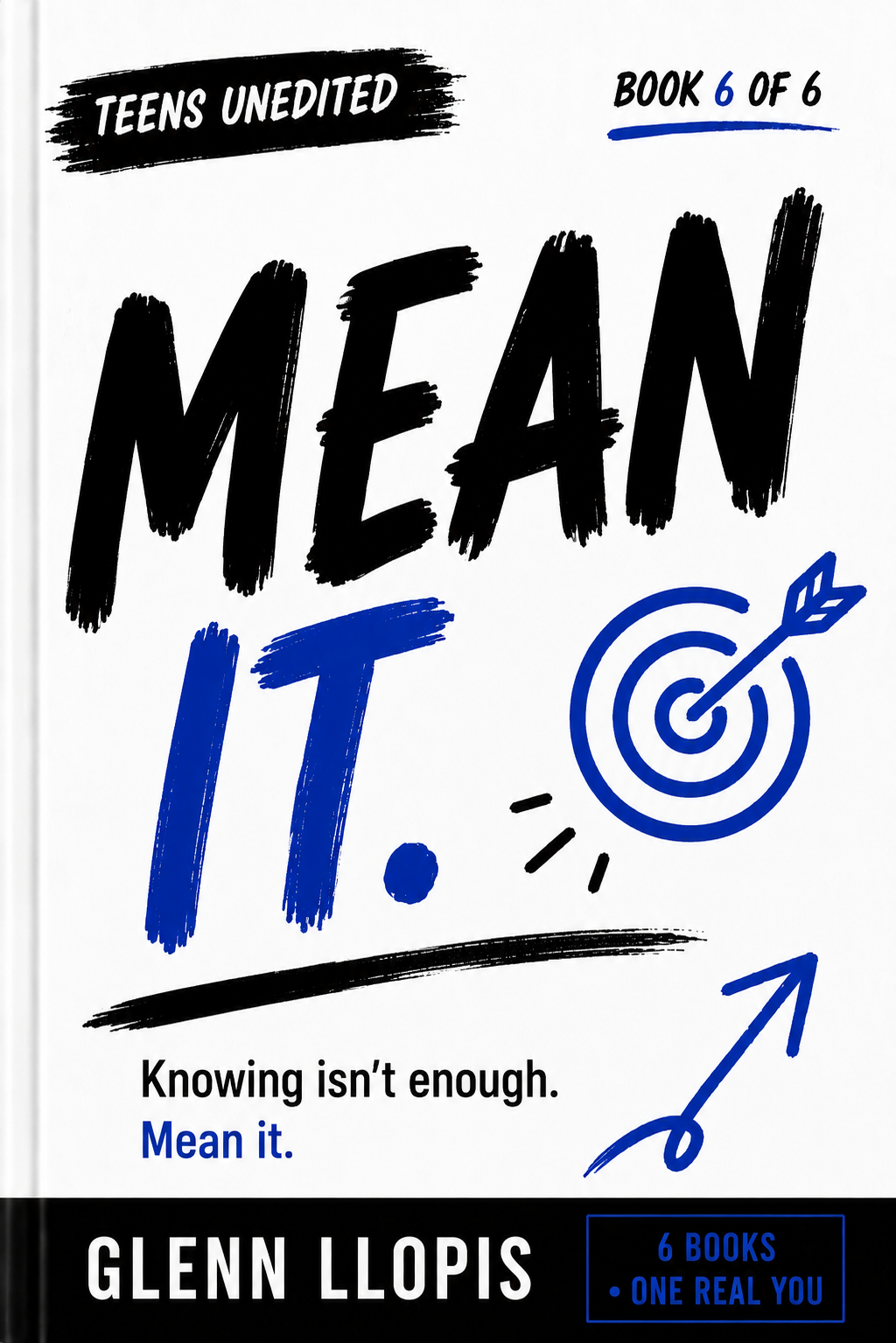
The only book that tells a reader what the other five were doing. Reinvention without conviction is change with no center, a shape that keeps moving because nothing underneath it holds. Conviction without reinvention is rigidity, a self too stiff to grow. Conviction was never something to declare. It is the record you build by doing hard things and surviving them, and a teenager finishing this book discovers they have been accumulating it since page one of Book 1 without being told. Drop the act. Stop waiting to be picked. Prove it every day.
The adults in this work spent decades performing a version of themselves and have to find their way back. That is difficult, and it is what most of this site is about. A teenager’s situation is different in kind. They have not built the self yet.
The mechanism is specific. A young person feels something they cannot name. They sit with it, try a sentence, try another, and somewhere around the fourth or fifth attempt they find language that fits, and discover something they did not know they believed. That is not writing practice. The articulation and the self arrive together.
A tool that supplies the words closes that gap before they ever experience it. And it closes it well: the output is fluent, appropriate and competent. It just did not come from anywhere inside them.
The Conviction Crisis radiates through five rings: self, home, organization, community, generation. For a teenager the rings are the same shape with different names, self, home, school, peers and screen, and the same protective factor keeps appearing in all five. Belonging. A room where the actual person has a seat.
The method is aligned to all five CASEL competencies, which is what allows the work to sit inside a curriculum rather than beside it. The six books arrive February 2027.
See the evidence base at Teens UnEdited →Back to Teens →AI and identity: the full argument →Take the Conviction Diagnostic. In three minutes, see where you've traded who you are for who the room wanted, and exactly where to begin reclaiming it.

His story starts where reinvention did: a family that left everything behind for a new country and refused to call it loss. Cuban Roots →
.svg)
.svg)
.svg)
.svg)
.svg)
.svg)
