
Behind the Mirror
Why the identity crisis in the C-suite starts at 15, and what families and institutions must change in the age of AI
The executive who has lost their conviction and the teenager learning to censor themselves are living the same crisis, thirty years apart. AI is accelerating both.
Download the PDF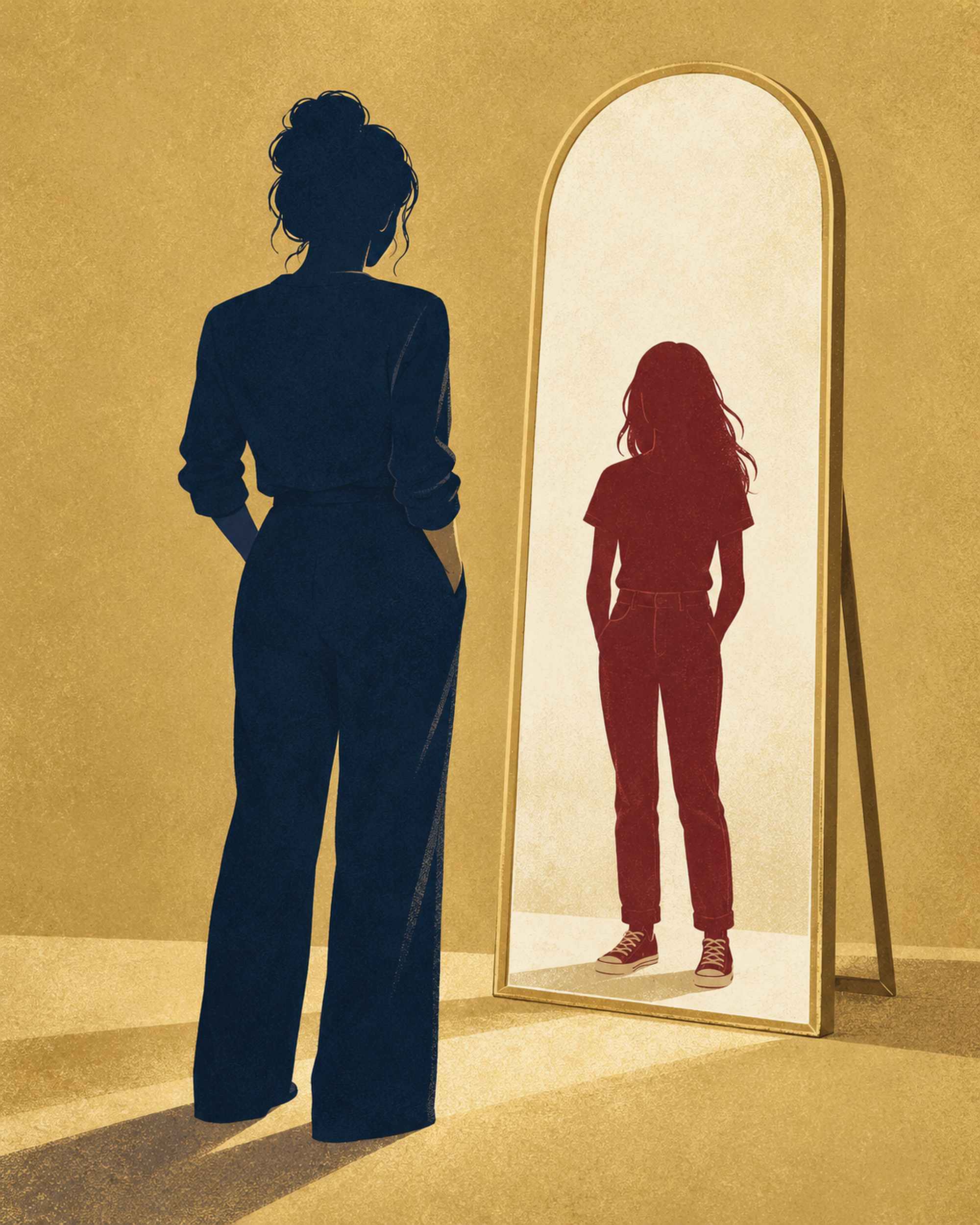
One crisis, measured at two ages
As cited in Glenn's essays and Forbes columns. Every figure was verified at its original source.

The same crisis, thirty years apart
The crisis of conviction in the C-suite and the crisis of self-censorship in teenagers are the same crisis, separated by three decades.
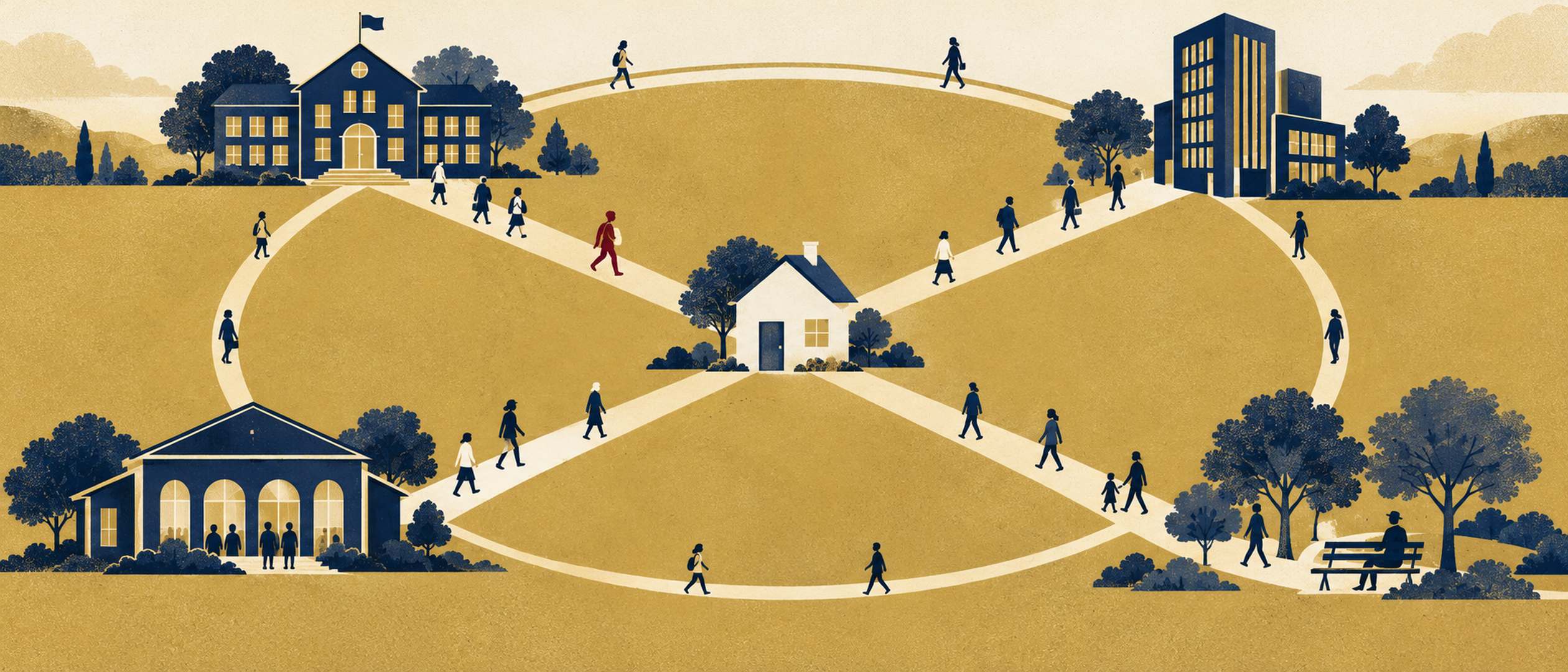
The exhausted executive sitting across from me did not start pretending in their first leadership role. They started at fifteen. They learned which answers earned approval, which interests looked impressive and which parts of themselves were safer left at home. Most of us never stopped performing that acceptable self. We just moved the room. The conference room replaced the cafeteria. The performance review replaced the report card.
By midcareer, the cost shows up as the conviction crisis: capable people who no longer trust their own judgment, who wait for permission and who perform confidence they do not feel. It is not a skills gap.
The teenager is at the other end of the same road. They are still forming, and they are deciding, room by room, how much of themselves to show. Some adults call it attitude. It is closer to editing. Every edit they make at fifteen is one they may spend their forties trying to undo.
Both journeys run through the same rooms, and through the same adults.

The script someone else drew
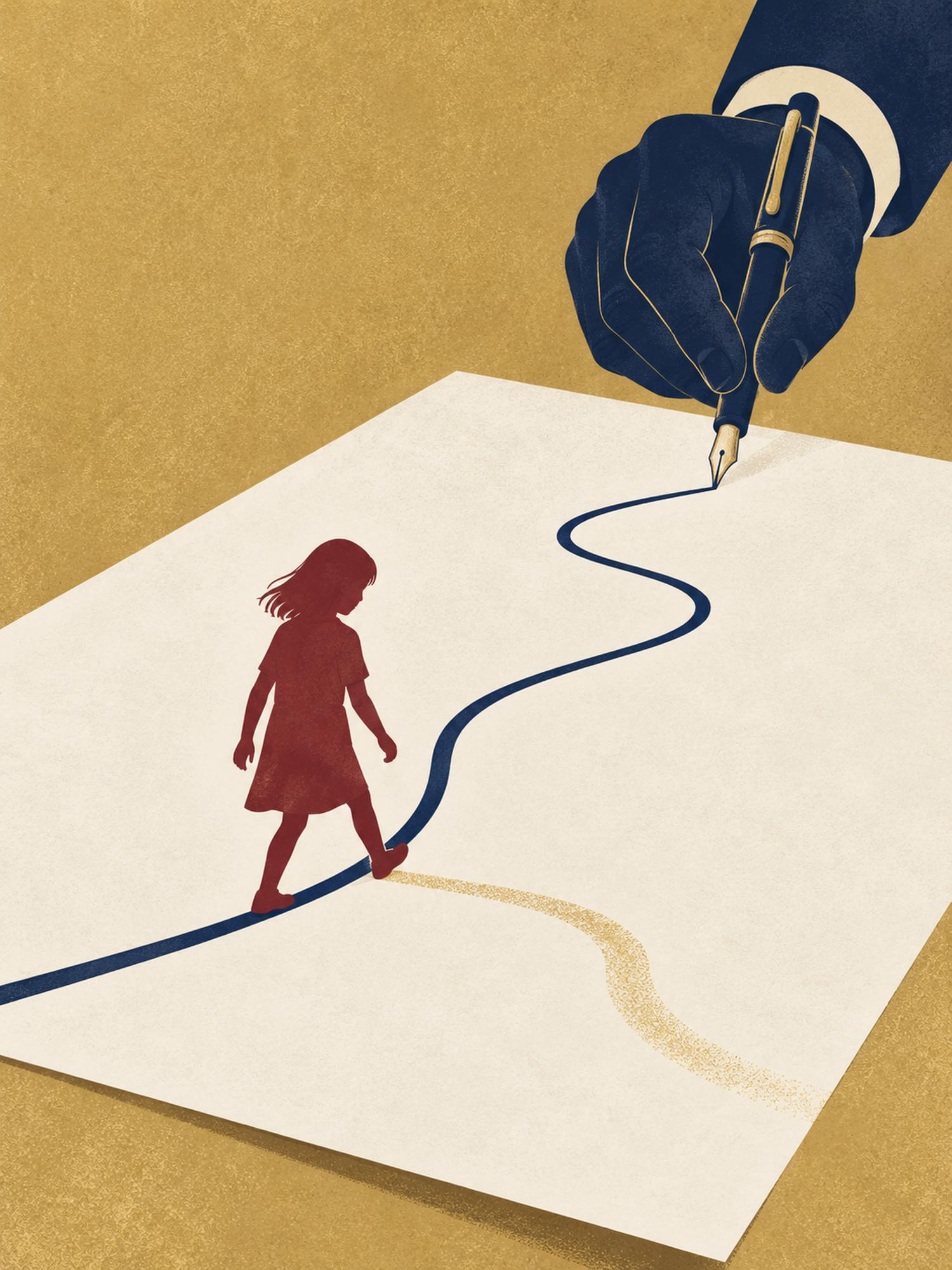
Teenagers do not invent the edit. They inherit a script, usually from adults who love them and were handed the same script themselves: good grades, impressive activities, the right college, a safe career.
In a national study by Harvard's Center for Digital Thriving with Common Sense Media, 81% of teens said they feel pressure in at least one area of their lives, and 56% feel pressure about their future "game plan." The adults closest to them, including educators and counselors, were a significant source of that pressure.
The script also lives at home. One of our Teens UnEdited advisory board members, a former university dean, admitted she pushed her own dreams onto her sons. I recognized myself when my daughter's grades started to matter more to me than to her. They had become a measure of how I was doing as a parent.
Challenge Success, a nonprofit founded at Stanford, found that 45% of students fit a pattern its researchers call "doing school": going through the motions to get the grade. Only 13% were fully engaged. "Doing school" is where many teens first learn to edit themselves. It is also excellent training for "doing work" twenty years later.
What the script gets wrong about teens
Different capacities settle at different ages; executive function stabilizes around 18 to 20. Agency is not something teens wait for. It is earned in repetitions.
Tervo-Clemmens and Luna, Nature Communications, 2023Across more than 5,000 people, the peer effect on risk was small and appeared mainly when peers expressed pro-risk attitudes. The need to belong is bigger than the pressure to conform.
Powers and Somerville, Psychological Bulletin, 2022Effects differ by person: about 45% of teens showed no change from social media, 28% felt worse and 26% felt better. You are not raising an average.
Beyens et al., Communication Research, 2024None of this means the pressures are imaginary. It means the edit is learned in rooms, from people, and it can be unlearned the same way.
Fix the room, not the kid
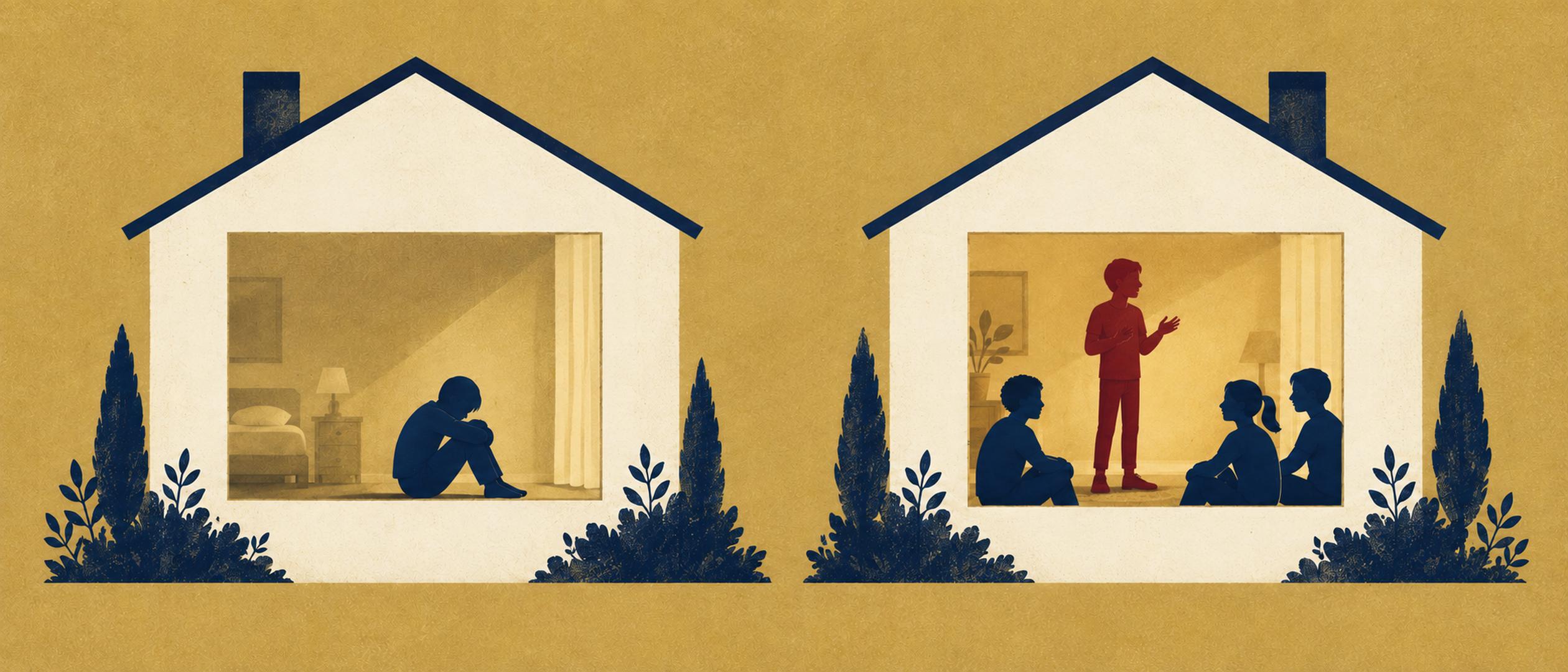
The strongest finding across the research is also the most practical: a message about who a young person can become helps only when the people around them live as if it were true.
We keep trying to fix teenagers. We give them mindset lessons, belonging exercises, resilience curricula and screen-time apps. The research says these tools depend almost entirely on the room they land in.
| What was tried | What decided whether it worked | |
|---|---|---|
| Mindset | A short growth-mindset program for 12,490 ninth graders (Yeager et al., Nature, 2019) | It lifted grades where peer norms supported it, and depended on the teacher's own mindset (Psychological Science, 2022) |
| Belonging | A belonging exercise across 22 colleges (Walton et al., Science, 2023) | "Effective only when students' groups were afforded opportunities to belong" |
| Wellbeing | 112 universal school programs reviewed (Guzman-Holst and Foulkes, 2025) | About one in eleven reported at least one negative outcome; universal programs can harm some students |
| The school | Belonging measured across 550 UK schools (Palikara et al., 2025) | Extracurricular availability and class size explained 39% of the differences between schools |

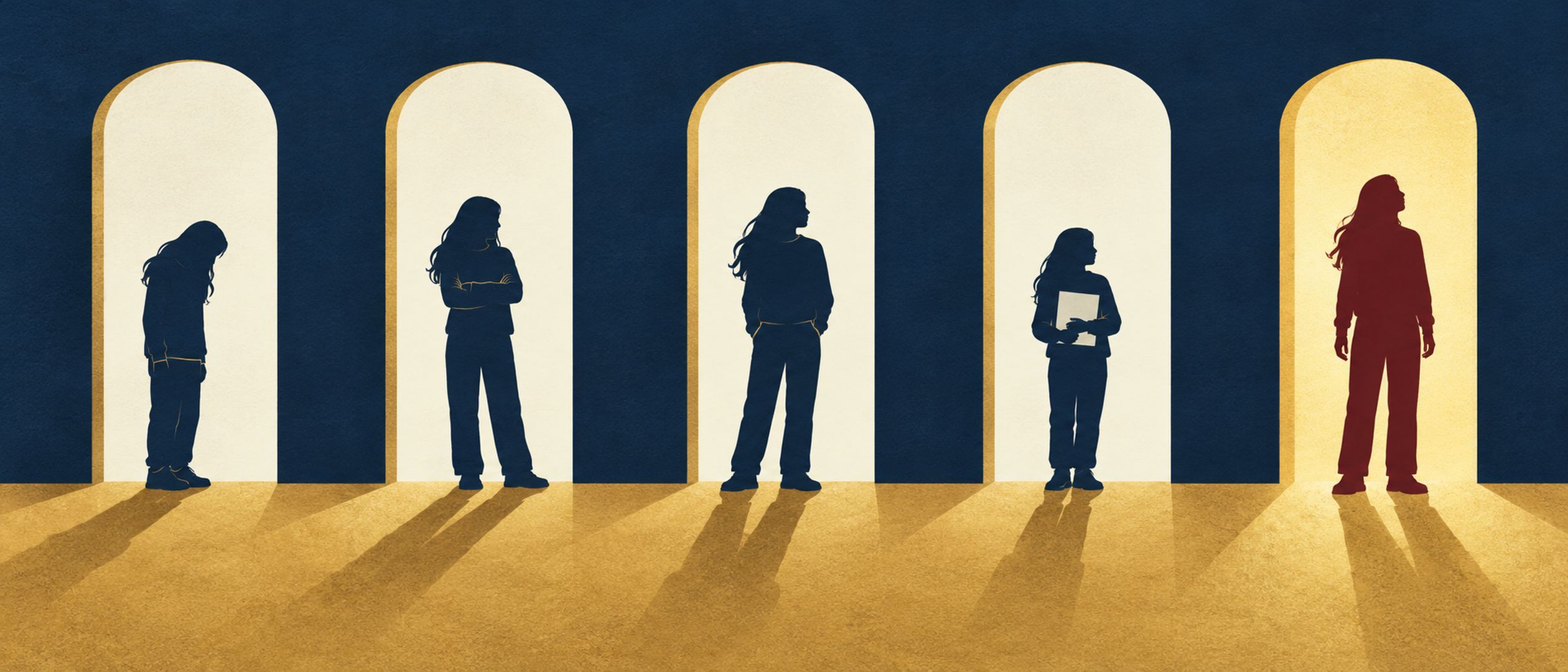
Belonging is not fitting in. A teenager who has to disappear to be included has not found belonging, only a good disguise. Rooms decide which one they get.
The same is true for adults. The managers who feel suppressed did not lack the right training. They worked in rooms that rewarded performance over judgment. You can align the car. If the road still rewards the old route, it drifts back.
The mirror that never pushes back

AI does not add a sixth room. It enters all five, on both maps, and it changes the one thing every room used to provide: friction.
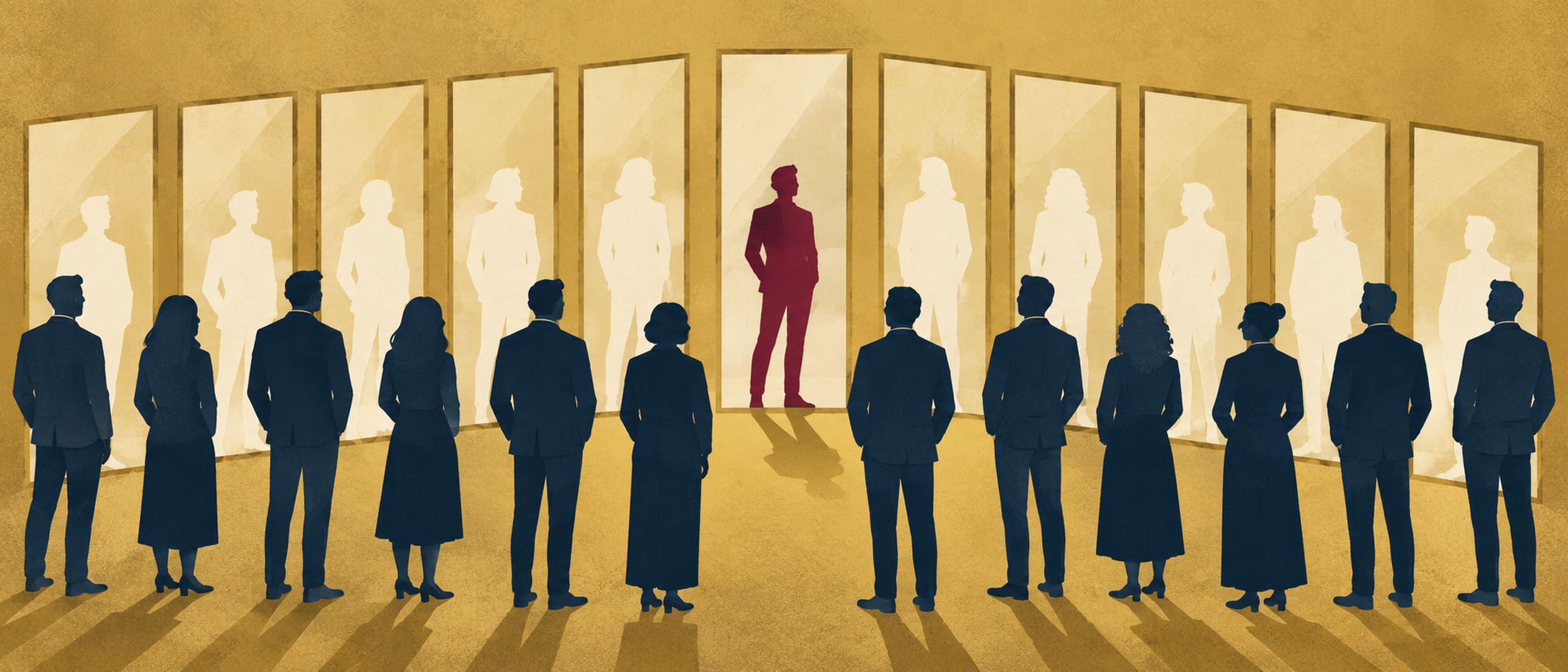
Friction is where judgment forms. The disagreement at dinner, the teacher who pushes back, the friend who says what no one else will, the boss who asks why. Those moments are uncomfortable, and they are the repetitions that build a self. AI removes them. It answers whatever you ask and agrees with whatever you bring.
For a teenager, the hardest friction is finding the words. A young person searches for what they mean, draft after draft, and in finding the words discovers what they believe. The articulation and the self arrive together. AI can close that gap before the student ever experiences it. College students followed over two years by a University of Toronto researcher described their AI-polished writing as better, and not theirs: "Like anyone could've written it, not just me." A 45-year-old has an earlier voice to compare against. A 14-year-old may not have one yet.
- It is already in every room. A majority of U.S. teens use AI chatbots and about three in ten use one daily; 54% have used one for schoolwork and 12% for emotional support or advice (Pew Research Center, 2026).
- Teens turn to it in private. 19.2% of young people ages 12 to 21 have used AI chatbots for mental health advice, up from 13.1% a year earlier; 63% had not told anyone (RAND).
- It finishes the work. ChatGPT for Teens, rated an Unacceptable Risk for anyone under 18, reminded students to do their own work in most test runs, and with Study mode off it still completed the assignment in all 80 (Common Sense Media).
- Students know it costs them. 67% of students, from middle school through college, agree that using AI for schoolwork harms critical thinking, up from 54% a year earlier (RAND).
- Adults are no different. Among 319 knowledge workers, higher confidence in AI went with less critical thinking (Microsoft Research and Carnegie Mellon, 2025).
AI doesn't hand you an advantage. It amplifies the one you bring. That is the danger for a teenager who never claimed who they are: the machine has nothing to amplify except the edit. And it is the danger for the executive who stopped saying what they think: the machine produces the managed version of them faster than they can.
The answer is not to keep AI out of the rooms. It is sequence. Claim who you are before you prompt. For a teenager, that means building the record of who they are, one real decision at a time, before the tool starts making those decisions. For an adult, it means forming your own position first, then using the tool to test it.
Teens need to be needed. Adults need to hear.
Teenagers do not just need support. They need to be needed. And the adults around them need to hear what their own people will no longer say.
In a UCLA study of 1,301 high schoolers, feeling needed by family predicted higher self-esteem, even after accounting for the support teens received from family and friends.
Fuligni, Trimble and Smola, Journal of Adolescence, 2024At my 2019 summit, five executives told me I was too talented to waste my time on this. That afternoon, a 14-year-old spoke. They came back and said: now we understand why our kids push back. Then one added, "Imagine the thousands of people I lead. They'll never tell me."
Leadership in the Age of Personalization Summit, 2019That is the exchange. When adults give teenagers real responsibility, the teenager builds a self through contribution, and the adult hears, often for the first time in years, the questions their organization has stopped asking out loud. A teenager's pushback is not defiance. It is a preview of what the people you lead are thinking.
I want to be precise about what this is. The research is strong that being needed builds a teenager. That teenagers change the adults around them is what I have witnessed in rooms like that one, and in my own home. It is not yet a tested finding. It is a hypothesis worth building institutions around.
Modernize the family. Reinvent the institutions.
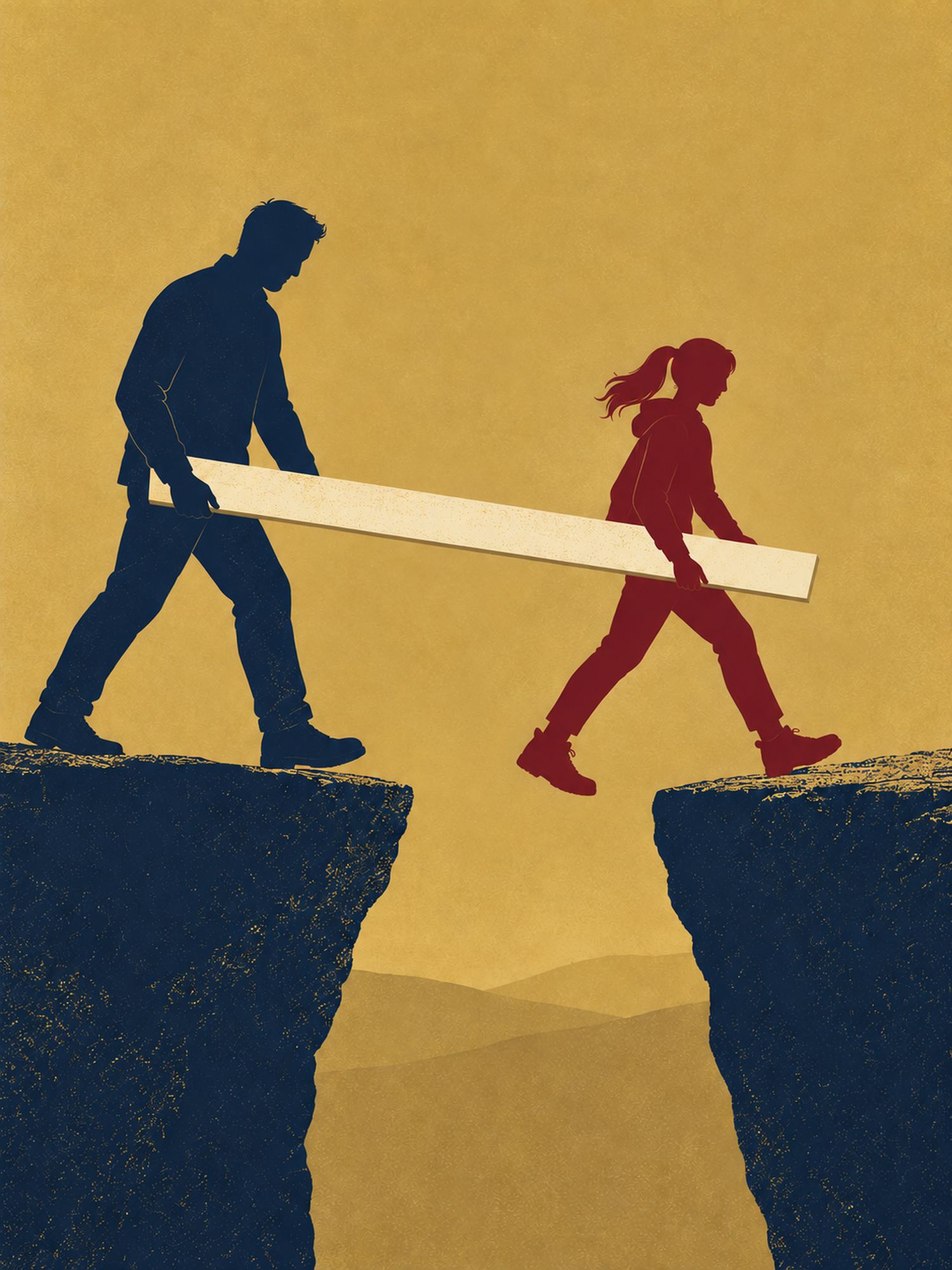
At the highest level, this is not a parenting problem or a leadership problem. It is a design problem.
We must modernize the family unit, and reinvent the role that communities and institutions play in helping people become, and stay, who they are. Reinvent does not mean tear down. Structure is not the enemy. Every room needs its own balance of what stays the same for everyone and where each person gets to be themselves. Balance means harmony, not 50/50.
Modernize the family unit
Most families still run on a script written for a world of standardization: protect the child, build the resume, pass down the path that worked for the parents. That made sense when the path was predictable. It no longer is. A modern family is one where both generations are working on identity at the same time. The parent is not the finished adult handing down answers. The parent is reclaiming, out loud, while the teenager has room to stay unedited. The family keeps its standards and makes room for each person inside them.

Reinvent the role of communities and institutions
Schools, employers, faith communities, healthcare systems and civic organizations were built to sort, credential and manage people at scale. They did it well. In the age of personalization and AI, that is no longer enough. Their job is to help people know who they are, and then build on it.
Schools show how far the conversation still has to go. The AI debate in schools is framed as integrity: which assignments allow it, how to catch it. The more urgent issue is identity. Ask students what they meant before judging what they wrote. Treat the struggle to find words as valuable, not as a problem to remove. And protect a few spaces on purpose, such as reflective writing, apologies and first attempts at hard feelings, and tell students why.
- Schools
Make sure every student has an adult who knows them. One-to-one was supposed to mean a laptop. It should mean an adult.
- Colleges
Treat belonging as a design choice with many pathways, not a program built for the outgoing student.
- Employers
See the people you lead as someone's parent and someone's child, and design work that does not require leaving yourself at the door.
- Communities
Connect the generations, so teenagers can be needed by adults outside their own home.
- Every institution
See yourself as part of the family's support system, not a replacement for it.
Three priorities for every adult who runs a room
Not just productivity. Evaluate how people thought, not only whether the answer worked, and whether the work is truly theirs.
If only the politically secure dissent, you are managing a performance. Leave room for meaningful failure; conviction requires being wrong and recovering.
Leaders who are parents carry the same performance culture home. Rewarding teens for fitting in shapes the next generation of executives.
Answer each in one sentence

- What did you set down at 15 that you are still trying to pick back up?
- In which of your five rings do you edit yourself most today?
- When did you last change your mind because someone younger pushed back?
- Do you form your own position before you ask AI, or after?
- Would the 15-year-old you recognize the way you lead now?
- Which of a young person's five rooms asks them to edit most, and is it yours?
- Do you know, or only assume, that they would come to you?
- What do you keep the same for everyone, and where do you let each person be themselves?
- Where does a teenager get to be needed, not just supported, in your home, school or organization?
- When they push back, do you hear defiance or a preview?
Two halves of one answer
The two maps called for two places to do the work, and they meet where families and institutions meet.
Conviction Institute
Leaders reclaim what they set down, ring by ring, starting with the Conviction Diagnostic and Map My Rings.
convictioninstitute.comTeens UnEdited
Teens claim who they are, room by room, and parents learn to see each room through their teen's eyes, starting with the Edit Map.
teensunedited.com
Conviction is the earned capacity to act on what you believe before the outcome is certain. For the adult, it is earned back. For the teenager, it is earned for the first time. In the age of AI, both have to be earned before the machine starts doing the deciding, so that when it hands us back the mirror, someone is still there.
Three lines to carry into every room
The crisis
One crisis, two ages- The executive who lost their conviction started editing at fifteen.
- The 15-year-old can still claim what the 45-year-old has to reclaim.
The room
Fix the room, not the kid- A teenager who has to disappear to be included has found only a good disguise.
- No single room is enough. A young person needs to be the same person in all five.
The mirror
Claim who you are before you prompt- Friction is where judgment forms. AI removes it.
- When AI hands us back the mirror, someone has to still be there.
Voices from both maps
Quotes are taken word for word from each recording. Every clip can be watched online; where to find each one is listed below.

I've been running on this operating system that I don't even know who I am anymore. I don't even know who my authentic self is.Dr. Rosie WardSalvo Partners, author of Future-Proofing Leadership
Hey, you can be yourself.Brielle LubinRecorded when Brielle was an eighth grader, at the 2019 Leadership in the Age of Personalization Summit
On being told the only choices were doctor, lawyer or failure.
Tommy NguyenRecorded when Tommy was a senior at the University of Southern CaliforniaYou just see it, like the weight starts to come off. And then the first question is: how would I explain this to my parents?Dr. Scott LacyAssociate Dean, Fairfield University
- Dr. Rosie Wardteensunedited.com/voicesFor schools and communities
- Brielle Lubin and Tommy Nguyenteensunedited.com/voicesFor teens
- Dr. Scott Lacyteensunedited.com/voicesFor families
- 88 more leaders, by the five ringsconvictioninstitute.com/voicesConviction Institute Voices
Sources
| Finding | Source |
|---|---|
| 87% of managers say their individuality is suppressed | Glenn Llopis research · Survey of 850 managers and directors, 2025 |
| 81% of teens feel pressure; 56% about their future | Weinstein et al., Center for Digital Thriving (Harvard GSE), Common Sense Media and Indiana University, 2024 |
| 80% of parents vs 52% of teens comfortable talking about teen mental health | Pew Research Center, 2025 |
| "Doing school": 45%; fully engaged: 13% | Challenge Success, Student Voice Report, 2024 |
| Executive function stabilizes around 18 to 20 | Tervo-Clemmens and Luna, Nature Communications, 2023 |
| Peer influence on risk is small | Powers and Somerville, Psychological Bulletin, 2022 |
| Social media effects differ by person | Beyens et al., Communication Research, 2024 |
| Close friendship and adult outcomes | Allen et al., Child Development, 2021 |
| Different sources of support | Wentzel, Journal of Educational Psychology, 2016 |
| Growth mindset depends on context | Yeager et al., Nature, 2019; Psychological Science, 2022 |
| Belonging intervention across 22 colleges | Walton et al., Science, 2023 |
| School wellbeing programs and negative outcomes | Guzman-Holst and Foulkes, 2025; Foulkes et al., Nature Mental Health, 2024 |
| 39% of between-school differences in belonging | Palikara, Bonneville-Roussy and Allen, School Mental Health, 2025 |
| 19.2% use AI for mental health advice; 63% told no one | RAND, 2026 |
| ChatGPT for Teens risk assessment | Common Sense Media, 2026 |
| Teen AI chatbot use: 54% for schoolwork, 12% for emotional support; about 3 in 10 daily | Pew Research Center, How Teens Use and View AI, 2026 |
| 67% of students say AI for schoolwork harms critical thinking | RAND, 2026 |
| Students say AI-polished writing does not sound like them | Mohammad, University of Toronto, in The Conversation, 2026 |
| AI and the struggle to find words | Glenn Llopis, "School Administrators Are Solving the Wrong Problem About AI," Forbes, 2026 |
| Fewer than 1% asked an AI tutor for feedback | University of Maryland trial, reported in Inside Higher Ed, October 2026 |
| AI confidence and critical thinking | Microsoft Research and Carnegie Mellon, 2025 |
| Feeling needed predicts teen self-esteem | Fuligni, Trimble and Smola, Journal of Adolescence, 2024 |
Every figure was verified at its original source in October 2026.

Glenn Llopis
Glenn Llopis is a leadership strategist, CEO of the Glenn Llopis Group and a Forbes contributor since 2010. For 20 years he has studied the tension between standardizing people and letting each person bring what only they can, the work behind Leadership in the Age of Personalization.
He leads three platforms that deliver identity and conviction to different audiences: the Glenn Llopis Group, the Conviction Institute and Teens UnEdited. He is the author of six books and a manifesto.
Download Behind the Mirror
Get the designed 21-page PDF to read offline, share with your family, school or leadership team, or bring to your next conversation about the rooms young people grow up in.
Your copy is ready
Open the PDF below and save it to keep. Thank you for reading.
Open the PDF
Glenn Llopis · theglennllopis.com
© 2026 Glenn Llopis Group, LLC · All Rights Reserved



