.svg)
Individuality
·
Culture
Belonging Isn't Fitting In. The Research Can Tell the Difference.
Fewer than half of students in one large survey said they could really be themselves at school. The research on belonging suggests that gap matters for years, and that belonging only works where a teen's real self has a place in the room.
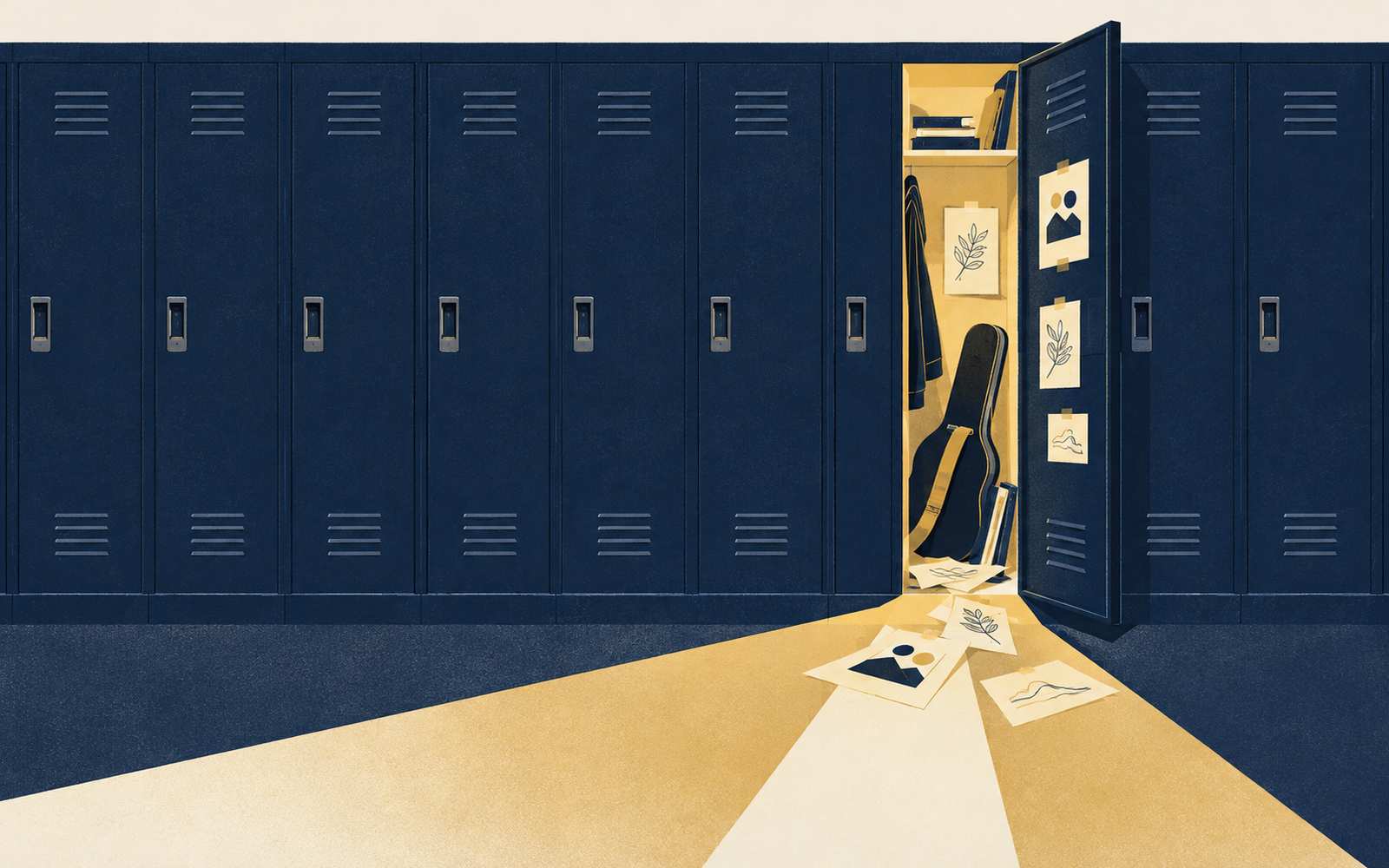
There is one line on a student survey that I keep coming back to. It doesn't ask whether a teenager has friends, joins clubs or likes their teachers. It asks whether this statement is true: "I can really be myself at this school."
Denise Clark Pope of Stanford and her colleagues at Challenge Success put that item to about 55,000 high school students at 73 public and private schools. Only 42% said it was quite or completely true, and 28% said it was not at all or only a little true. These schools were not a national sample, so the numbers describe the students surveyed rather than every American teenager. Still, sit with it. In schools that care enough to ask, fewer than half of the students felt free to show up as themselves.
That gap is what this essay is about, because I think we use one word for two very different experiences. One is belonging. The other is fitting in. From the outside they look identical. From the inside they feel nothing alike.
What a Fifteen-Year-Old Carries Into Their Twenties
Belonging is not a soft topic. Kelly-Ann Allen at Monash University and her colleagues followed 1,568 Australians in the long-running Australian Temperament Project. Those who reported a stronger sense of school belonging at 15 and 16 went on to report fewer symptoms of depression, anxiety and stress at ages 19 through 28, even after the researchers accounted for their symptoms at 13 and 14.
That is a correlation, and Allen treats it as one. Belonging at 15 went with better mental health a decade later. The study cannot prove that one caused the other. But a link that holds across that many years deserves a parent's attention.
Allen has also named the problem I care most about. In a 2025 review of the field, she records the concern, raised by psychologist Mark Leary and others, that belonging is often blurred together with acceptance and fitting in. Researchers are still sorting out those definitions. Families can't wait for them to finish, because the blur shows up in real hallways every day.
Why Matching the Popular Kids Feels So Good
Fitting in is a trade. You read what the room rewards and you adjust. Teens are remarkably good at it, and the pull starts early. In an online chat room experiment with 250 young adolescents, average age nearly 13, a team led by first author Field and Mitchell Prinstein of the University of North Carolina, with Stanford's Geoffrey Cohen, looked at what happens when kids go along with peers presented as popular. For boys, conforming to high-status peers went with feeling more aligned with them, and that alignment went with higher self-esteem. The pattern did not show up for girls, and it was measured in a single session, so it describes an association rather than a cause.
Still, it helps explain why fitting in is so easy to mistake for belonging. For some kids, the boost of matching the crowd is real in the moment. The cost arrives later, when the version of you that got accepted is not the one you actually are, and you have to keep performing it to stay inside.
A Welcome Message Needs a Seat Behind It
Schools have noticed the stakes, and many now run belonging programs. Some of the strongest evidence comes from Gregory Walton at Stanford. His team ran a randomized trial with 26,911 incoming college students at 22 institutions. A short online exercise completed before college, under 30 minutes long, raised the rate at which students finished their first year as full-time students, especially in groups that had historically progressed at lower rates.
Then came the finding that matters for every parent of a high schooler. The intervention, the researchers wrote, "was effective only when students' groups were afforded opportunities to belong." Telling students they belonged helped in places that actually had room for them. Where the setting offered no real seat, the message alone did not carry the weight.
To be fair to the skeptics, independent evaluations of similar college belonging exercises have found inconsistent results, and Walton's own team now frames the question as where and with whom these exercises work. I read that caution as support for the larger point. Belonging depends heavily on the room.
A 2025 analysis led by Palikara and Bonneville-Roussy, with Allen as co-author, points the same way. Among 14,157 fifteen-year-olds in 550 UK schools, students' motivation, gender and family income explained 6% of the differences in belonging among students, while the availability of extracurricular activities and class size explained 39% of the differences between schools. Again, that is correlational. But it suggests that what a school offers may shape belonging more than any single student's personality.
Listening for the Difference at Home
Ask the survey question yourself. Skip "Do you like school?" and try "Where can you really be yourself there?" Notice which rooms your teen names and which ones they leave out.
Listen for the gap between being included and being known. A teen who fits in can tell you what the group likes. A teen who belongs can tell you what the group likes about them.
Ask the school what it offers beyond the standard path: clubs, smaller classes, adults with time to notice. Allen's earlier meta-analysis of 51 studies covering 67,378 secondary students found that teacher support and students' positive personal characteristics were the strongest predictors of school belonging. Shared schedules, rules and expectations give a school its spine, and teens need that structure. The right balance comes when those common structures still leave space, class by class, for the student who doesn't match the mold. I explored that idea for adults in Belonging Comes Before Collaboration, and it starts much earlier than the workplace, as I wrote in Students and Educators Need Permission to Be Individuals.
A teen who has to disappear to be included hasn't found belonging yet, only a good disguise. So the next time your teen tells you they fit in fine, ask the follow-up: fit in as who?
Research cited
Pope, D. C., & Miles, S. (2022). A caring climate that promotes belonging and engagement. Phi Delta Kappan.
Allen, K.-A., et al. (2024). Adolescent school belonging and mental health outcomes in young adulthood: Findings from a multi-wave prospective cohort study. School Mental Health.
Allen, K.-A. (2025). School belonging: Evidence, experts, and everyday gaps. Educational Psychology Review.
Field, N. H., et al. (2024). Why adolescents conform to high-status peers: Associations among conformity, identity alignment, and self-esteem. Child Development.
Walton, G. M., et al. (2023). Where and with whom does a brief social-belonging intervention promote progress in college? Science.
Palikara, O., Bonneville-Roussy, A., & Allen, K.-A. (2025). Individual and contextual factors determining school belonging of adolescents in the UK: Evidence from PISA. School Mental Health.
Allen, K., et al. (2016). What schools need to know about fostering school belonging: A meta-analysis. Educational Psychology Review.
Want to explore these ideas further? Learn more about my work on leadership, identity and conviction at www.theglennllopis.com.
A teen who has to disappear to be included hasn't found belonging yet, only a good disguise.
© 2026 Glenn Llopis. All rights reserved.
This article is the original work of Glenn Llopis and is protected by copyright. It may not be republished, reproduced, distributed or adapted, in whole or in part, in print, online or by AI tools, without prior written consent. You are welcome to share the link or quote a brief excerpt with credit to Glenn Llopis and a link back to this page. For permission requests, contact solutions@glennllopisgroup.com.
Get the next essay in your inbox
New essays on leadership, identity and conviction, sent to you when they publish. Free, and you can unsubscribe anytime.
Thank you. You're subscribed to Conviction Chronicles.
Something went wrong. Please try again.



.svg)
.svg)
.svg)
.svg)
.svg)
.svg)
