Reinvention
·
Transformation
Change Designed Without the Bedside Never Reaches It
Most change in healthcare is designed far from where care happens. New data shows only 40% of employees feel heard on how changes roll out to their team, and 41% of nurses say their views rarely shape AI decisions. Changes built with the people who live them are the ones that last.
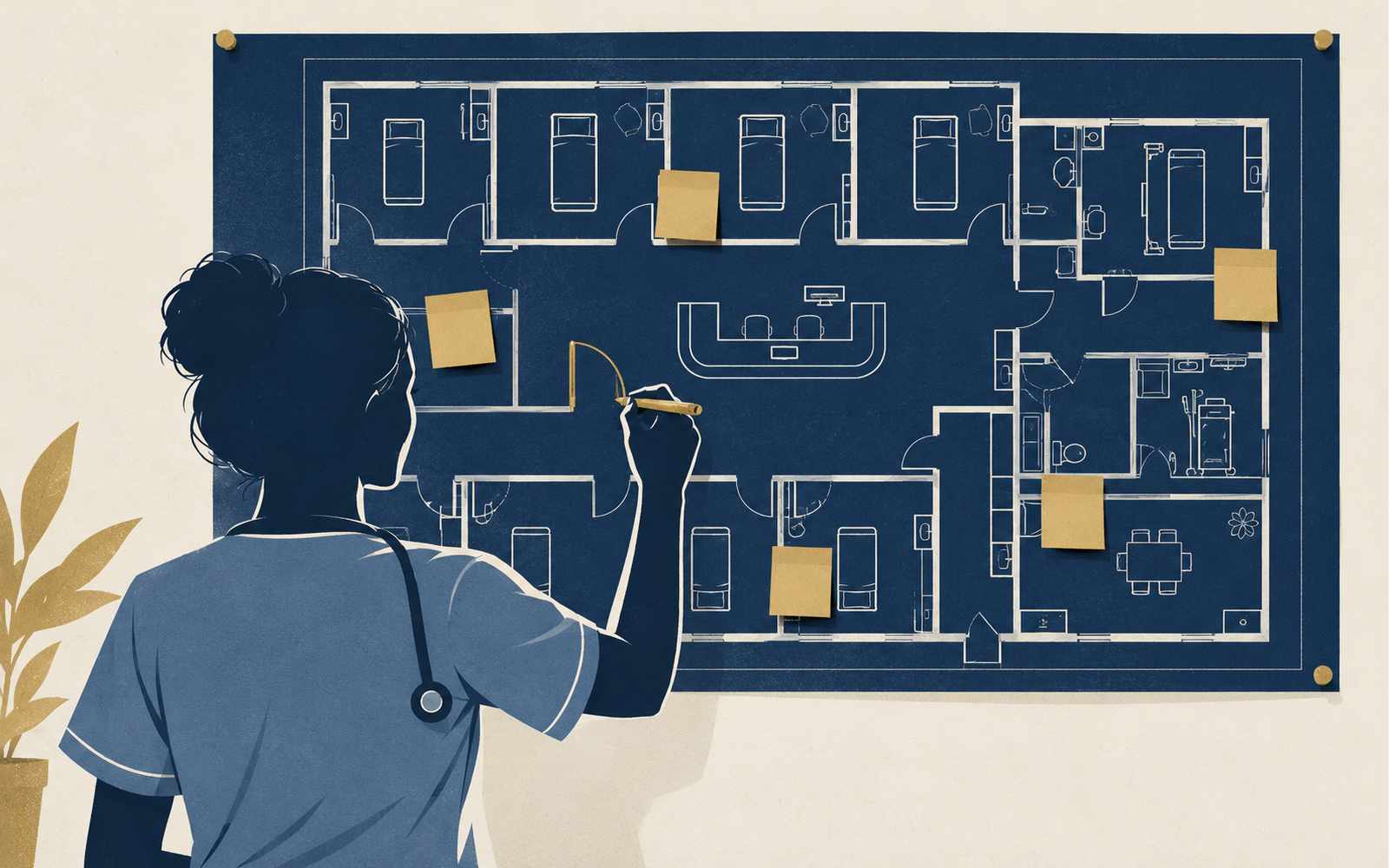
Every health system has a version of this story. A new workflow is designed carefully by a capable team. It is tested, approved and launched with training and a communication plan. Six months later, the units have found their own way around it, and leaders are asking why people resist change.
Usually they didn't resist the change. They resisted a design that never accounted for how their work actually happens.
The distance between design and delivery
Change in healthcare is mostly designed in conference rooms, project offices and vendor meetings. It is delivered at the bedside, at 2 a.m., with one more patient than planned. The farther apart those two places are, the more a good idea loses on the way down.
The data suggests that distance is common. Eagle Hill Consulting's 2025 survey of more than 1,400 U.S. workers found that only 40% felt heard about how changes should roll out to their own team. Just a third felt their input mattered in deciding which changes to prioritize, and only 24% agreed that change was carried out in a way that made it easy to embrace.
In healthcare, the newest wave of change is technology, and the pattern is the same. In Elsevier's 2026 Clinician of the Future study, 41% of nurses said their views are rarely or never reflected in decisions about AI. Only 19% of physicians thought nurses' views were being left out. The people making decisions and the people living with them see the same process very differently.
What the bedside knows that the plan doesn't
Frontline clinicians carry knowledge that rarely appears in any project charter. They know which step in a workflow gets skipped when the unit is full. They know which patients the standard process doesn't fit. They know where the supplies actually are, which handoff breaks down at shift change and why the last initiative quietly faded.
When that knowledge arrives after the design is finished, it shows up as complaints. When it arrives before, it shows up as a better design. Same people, same information. The only difference is timing.
There is also a matter of ownership. People defend what they helped build. A change that frontline staff shaped has advocates on every shift. A change handed to them has to be enforced.
Bringing the bedside in early
Invite clinicians before the solution exists. Bring frontline staff in while the problem is still being defined, not after the answer is chosen. Ask them what is broken and what they have already tried.
Test it where it will live. A pilot on a calm unit with extra support proves very little. Try the change on a typical shift, with typical staffing, and watch what people actually do.
Pay attention to the workarounds. When people create shortcuts around a new process, they are showing you where the design doesn't fit. Treat each workaround as feedback, not defiance.
Give credit by name. When a frontline suggestion changes the design, say so and say whose idea it was. Nothing encourages the next suggestion more.
Close the loop on what you didn't use. Not every idea can be adopted. Explaining why one wasn't keeps people offering them.
I have written about why what you built by hand won't scale by memo: a program carries its steps easily and its reasons poorly. Changes designed with the bedside carry their reasons with them. And as I described in AI's Last Mile in Healthcare Runs Through a 12-Hour Shift, technology adoption is decided by the people who use it in the middle of real work.
Design where the work is
Health systems will keep changing, and they need to. The question is not whether to change but where the change is shaped. The plans that reach the bedside are the ones that started there.
Before the next initiative launches, ask a simple question: which frontline clinicians helped design this, and what did they change? If the answer is no one and nothing, the work is not finished yet.
Want to explore these ideas further? Learn more about my work on leadership, identity and conviction at www.theglennllopis.com.
A change that never asked the people who live it will spend years trying to persuade them. Ask first, and much of the persuading is already done.
© 2026 Glenn Llopis Group, LLC. All rights reserved.
This article is the original work of Glenn Llopis and is protected by copyright. It may not be republished, reproduced, distributed or adapted, in whole or in part, in print, online or by AI tools, without prior written consent. You are welcome to share the link or quote a brief excerpt with credit to Glenn Llopis and a link back to this page. For permission requests, contact solutions@glennllopisgroup.com.
Get the next essay in your inbox
New essays on leadership, identity and conviction, sent to you when they publish. Free, and you can unsubscribe anytime.
Thank you. You're subscribed to Conviction Chronicles.
Something went wrong. Please try again.