.svg)
Opportunity
·
Opportunity
Teens Don't Just Need Support. They Need to Be Needed.
We give teenagers more support than any generation before, yet many still feel unsure of what they offer. A UCLA study of 1,301 high schoolers found that feeling needed by family went with stronger self-esteem. Here is why being relied on matters, and how parents can make room for it.
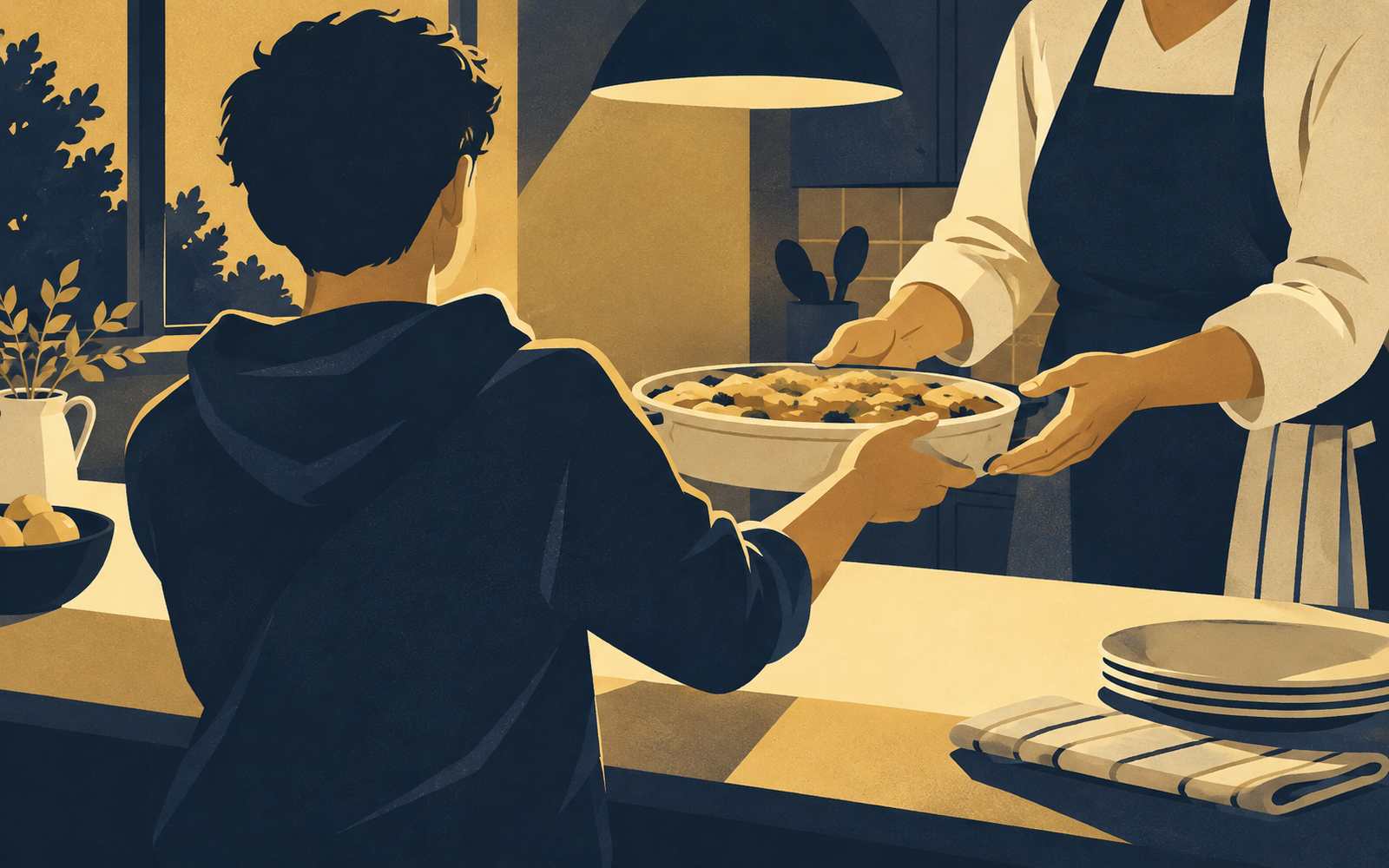
When was the last time your teenager did something that could not have happened without them?
I mean something real, where a person was counting on them and would have felt it if they hadn't shown up. A chore assigned to keep them busy doesn't count, and neither does a volunteer hour logged for an application.
Most of us pour enormous energy into supporting our kids. We drive, we pay, we tutor, we listen, we fix. That support matters, and I would never tell a parent to give less of it. But a growing body of research suggests we have been paying attention to only half of what teenagers need. They also need to be relied on.
What 1,301 High Schoolers Revealed About Being Relied On
UCLA psychologist Andrew Fuligni and his colleagues surveyed 1,301 U.S. high school students in grades 9 through 12 in the fall of 2020 and asked how needed and useful they felt to their families and friends. Feeling needed by family was the strongest predictor of self-esteem in their analysis, even after accounting for how much support those teens received from parents and peers. Teens who felt needed by family or by friends also reported less loneliness and a greater sense of meaning.
Two honest caveats. This was a snapshot taken at one moment, during the pandemic, so it shows that feeling needed went with better well-being, not that it produced it. The authors themselves say the findings need to be tested over time. Still, the pattern is worth noticing: once you know how much support a teen gets, knowing whether they feel needed tells you something more.
A second study points in the same direction. Linda Charmaraman of the Wellesley Centers for Women surveyed 967 young people aged 10 to 17. Among the LGBTQ+ teens in that group, giving support to friends online was associated with lower loneliness. Receiving support was not. That result comes from one subgroup in one survey, so I hold it loosely. But it fits the larger picture: for a teenager, being the one who helps may carry a weight that being helped does not.
Ronald Dahl of UC Berkeley and his colleagues offer a possible reason. In a 2024 review in Developmental Cognitive Neuroscience, they propose that "the motivational salience of mattering appears to increase in adolescence." That is a theory rather than a measured result, though it matches what many parents see at home: right when kids start pulling away from being taken care of, they start hungering to count.
Wanting, Needing and the Home I Grew Up In
My parents, Frank and Jenny Llopis, were Cuban immigrants. They raised my brother and me to know the difference between what we wanted and what we needed, to do what was right, and to serve others.
Those three lessons worked together. Knowing wanting from needing taught us to see what actually mattered, to us and to the people around us. Doing what was right gave us a standard to hold ourselves to. Serving others gave us a place to put all of it. And being expected to serve told us, without anyone having to say it, that we had something worth offering.
I think about that when I see how many teens today are surrounded by support and short on responsibility. We have made their lives smoother, and in the process we have made their contributions optional.
Being Counted On Shows a Teen What They Bring
This is where the research stops and my own conviction begins. When a teen is truly relied on, they learn something no aptitude test can tell them: what people always come to them for. One teen becomes the person who can calm a younger sibling down. Another is the one who figures out why the Wi-Fi keeps dropping. Another notices when a grandparent sounds lonely and picks up the phone. Those are not chores. They are early clues to who a young person is becoming, and the clues will keep changing as the teen grows.
When we only let teens receive, we take those clues away. They grow up well supported and strangely unsure of what they offer. Then we act surprised when they reach college or a first job still asking what they are good at. As I wrote in Agency Isn't Born. It's Earned in the Rooms We Create., young people build agency through real repetitions. Being needed is one of the most powerful repetitions there is.
Give Them Something That Depends on Them
Hand over an outcome, not a task. "Plan Sunday dinner for the family" teaches more than "set the table," because people are depending on the result.
Ask for help with something you genuinely don't know how to do, and mean it. Teenagers can tell the difference between being humored and being needed.
Notice what they do for others without being asked, and say it out loud. "I saw how you helped your cousin today. That mattered." You are telling them what you see in them, which is often the first time they see it themselves.
Let it matter when they don't follow through. If nothing changes when they skip it, the quiet message is that they were never really needed.
For educators, the same rule applies to classroom roles. The best ones are jobs the class would actually miss if no one did them.
A resume collects service hours. A person discovers what they are for. That difference is at the heart of Raise the Individual, Not the Resume, and it starts at home, long before any application asks.
Support tells a young person they are loved. Being counted on tells them they have something worth giving, and that is where conviction starts to be earned.
So this week, find one thing your family would genuinely do less well without your teen, and give it to them to carry.
Research cited
Fuligni, A. J., Trimble, A., & Smola, X. A. (2024). The significance of feeling needed and useful to family and friends for psychological well-being during adolescence. Journal of Adolescence.
Charmaraman, L., et al. (2024). Sexual minorities and loneliness: Exploring sexuality through social media and Gender-Sexuality Alliance (GSA) supports. International Journal of Environmental Research and Public Health.
Dahl, R. E., Armstrong-Carter, E., & van den Bos, W. (2024). Wanting to matter and learning to care: A neurodevelopmental window of opportunity for (pro)social learning? Developmental Cognitive Neuroscience.
Want to explore these ideas further? Learn more about my work on leadership, identity and conviction at www.theglennllopis.com.
Support tells a young person they are loved; being counted on tells them they have something worth giving.
© 2026 Glenn Llopis. All rights reserved.
This article is the original work of Glenn Llopis and is protected by copyright. It may not be republished, reproduced, distributed or adapted, in whole or in part, in print, online or by AI tools, without prior written consent. You are welcome to share the link or quote a brief excerpt with credit to Glenn Llopis and a link back to this page. For permission requests, contact solutions@glennllopisgroup.com.
Get the next essay in your inbox
New essays on leadership, identity and conviction, sent to you when they publish. Free, and you can unsubscribe anytime.
Thank you. You're subscribed to Conviction Chronicles.
Something went wrong. Please try again.



.svg)
.svg)
.svg)
.svg)
.svg)
.svg)
