
Reinvention
·
Transformation
The Collapse of Standardization Is No Longer a Prediction
In 2020, I called it the Collapse of Standardization. This week's election made it visible to everyone. The lesson isn't about who won. It's about what people will no longer accept from the institutions that serve them.
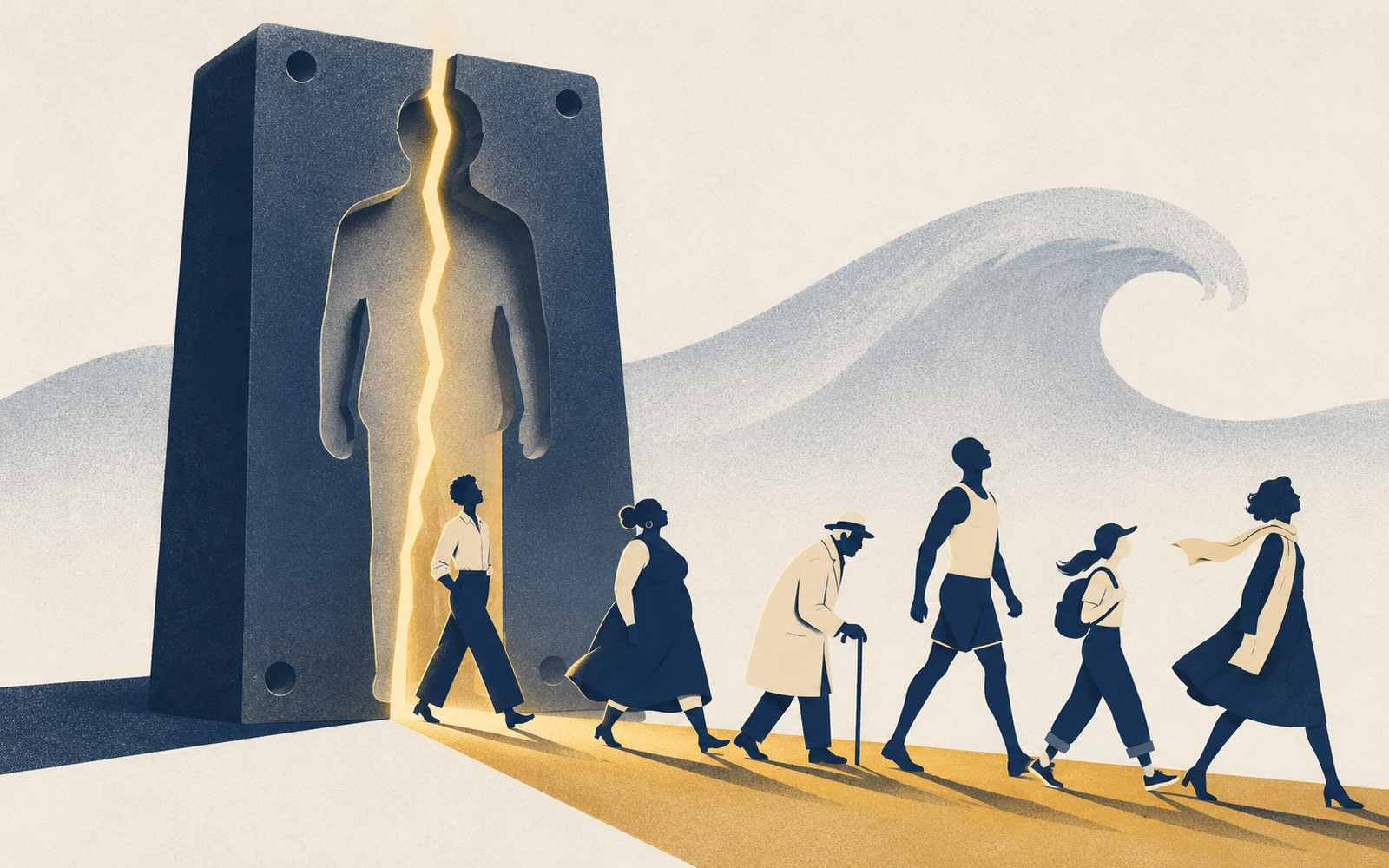
The Economist opened its lead editorial this week with an image from surfing. When a giant wave throws you off your board and pulls you under, you lose all sense of which way is up. Surfers call it the washing machine. The editors used it to describe what happened at the ballot box on November 3, but I think the image reaches much further than one election.
Leave the politics aside, and the editorial's most important lesson applies to every leader in every institution: people cannot be taken for granted. When they are frustrated enough, they will walk away from loyalties they have held for years. Just before the election, according to the polls the editors cite, 80% of Americans said they wanted "substantial change" or "complete and total upheaval" in how the country is run.
Eighty percent. That isn't a swing. It's a verdict on the old way of doing things.
I gave it a name in 2020
In 2020, I brought together leaders from healthcare, corporate America and higher education for a summit built around one idea. I called it The Collapse of Standardization.
My argument then was simple. For more than a century, our institutions were designed to standardize people: one way to work, one way to learn, one way to receive care, one way to be loyal. That model built enormous efficiency, and it deserves credit for it. But it rested on an assumption that people would keep fitting the mold. I believed that assumption was breaking, and that the cracks would spread across every sector at once.
Six years later, the cracks are everywhere. Employees no longer stay because they are supposed to. Patients no longer accept care designed for an average that doesn't describe them. Students question whether the path they were handed still leads anywhere. Customers switch brands the moment they feel unseen. And this week, voters made the same point in the most public way possible.
The common thread isn't anger, although there is plenty of that. It's that people refuse to be managed as a bloc. They want to be known as individuals, and they will hold any institution accountable that forgets it.
Collapse doesn't mean destruction
When people hear the word collapse, they picture rubble. That's not what I meant in 2020, and it's not what I see now.
Standardization was never the enemy. Every organization needs shared standards. They create fairness, consistency and the ability to grow. A hospital without protocols is dangerous. A company without common processes can't scale. The problem begins when standardization stops being a tool and becomes the entire philosophy, when the system expects people to shrink to fit it instead of serving the people inside it.
What's collapsing is that imbalance. Think of a cast mold with a crack running through it. The crack isn't the end of the form. It's the moment light gets in. The institutions that thrive in the years ahead will be the ones that let it in on purpose: keeping the standards that protect people while making room for what each person uniquely brings.
I call that a healthy tension. It isn't a 50/50 split between standardization and personalization. It's the harmony that fits a particular group of people, at a particular moment, with a particular mission. Finding it takes leaders who actually know their people.
What every leader should take from this week
The Economist's editors concluded that politicians must now spend less time stirring people up and more time getting things done for them. That advice works just as well in a boardroom.
Stop assuming loyalty. Your employees, customers and patients are not a captive audience. They are choosing you, or not, every day. Act as if their commitment has to be earned again this quarter, because it does.
Listen before the wave. Eighty percent didn't arrive at frustration overnight. The signals were there for years. Ask your people what they need now, not what they needed when your policies were written.
Keep the standards that serve people. Retire the ones that only serve the system. Look hard at your rules and ask who each one protects. The answer will tell you which ones to keep.
Lead the individual, not the segment. People are not demographics, generations or categories. When you lead them as individuals, they give you what no standard can produce: their best thinking and their conviction.
Coming up for air
The washing machine is disorienting, but surfers know what to do. You stop fighting the water, find which way is up, and swim toward the light.
That's where many institutions are right now. The old model of standardizing people is breaking apart, and no amount of pushing will hold it together. The leaders who come up for air first will be the ones who stop asking people to fit the system and start building systems that fit their people.
The collapse I named in 2020 was never a warning about the end of order. It was an invitation to build a better one.
Want to explore these ideas further? Learn more about my work on leadership, identity and conviction at www.theglennllopis.com.
The collapse I named in 2020 was never a warning about the end of order. It was an invitation to build a better one.
© 2026 Glenn Llopis Group, LLC. All rights reserved.
This article is the original work of Glenn Llopis and is protected by copyright. It may not be republished, reproduced, distributed or adapted, in whole or in part, in print, online or by AI tools, without prior written consent. You are welcome to share the link or quote a brief excerpt with credit to Glenn Llopis and a link back to this page. For permission requests, contact solutions@glennllopisgroup.com.
Get the next essay in your inbox
New essays on leadership, identity and conviction, sent to you when they publish. Free, and you can unsubscribe anytime.
Thank you. You're subscribed to Conviction Chronicles.
Something went wrong. Please try again.





