.svg)
Andrea Ferrara, Chief Human Resources Officer of PepsiCo Beverages North America, tells Glenn Llopis how a coal-town childhood shaped the way she leads, what three words replaced the old employee playbook, and what personalization looks like for machine operators and truck drivers.
Andrea Ferrara
Chief Human Resources Officer, PepsiCo Beverages North America (at the time of recording)
PepsiCo Beverages North America
·
Personalization Outbreak podcast
·
28
min
·
Episode
100
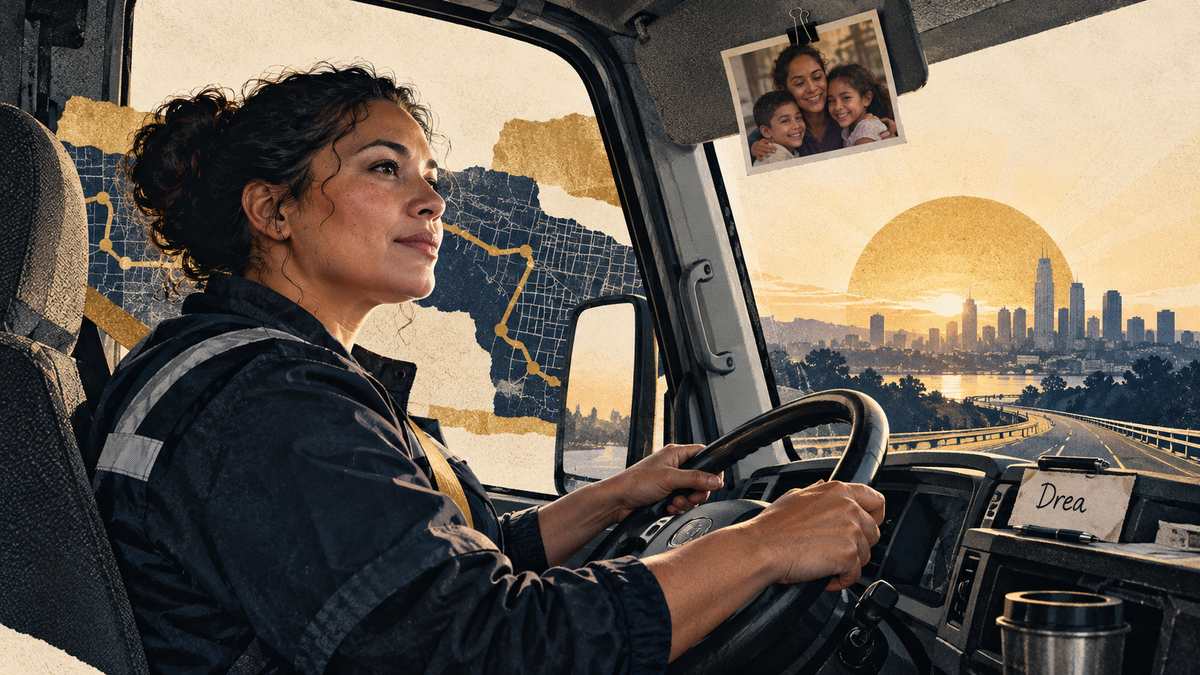
You don't see me as just the job or the machine operator or the CDL driver. You see me as Drea the person.
Andrea Ferrara
Andrea Ferrara, known as Drea, runs human resources for PepsiCo Beverages North America, a business whose workforce is mostly people on routes, in warehouses and on production lines. She joined Glenn Llopis on Personalization Outbreak to talk about what personalization means when the job is driving a truck rather than sitting in an office.
She starts with where she is from: a small town in western Pennsylvania built on coal and industrial work, in the years when the mines were closing. Watching her friends’ parents lose the jobs they had given their lives to is what pulled her toward labor economics, then labor relations, then a career inside one company. Glenn made the point that her backstory is not decoration:
"We oftentimes think that we're supposed to fit the role, but what's happening now is that the role is supposed to fit the individual" — Glenn Llopis · 00:04:57
PepsiCo had begun hearing about flexibility from frontline employees several years before the pandemic. Then the nice-to-have became a must-have overnight. Rather than add programs, her team went back to what people fundamentally needed and reduced it to three things: care, connection and career.
"people first and foremost want to know that you care and that you care about them as the individual, not the body in the job, but you care about me. The person." — Andrea Ferrara · 00:06:29
Connection came through loudest during the pandemic, from people who were risking their health to keep the business running and needed to feel tied to the place and the people they worked with. Career carried more weight too, because the job is how people provide for a family and fulfill themselves. Those three became what she calls their true north.
Glenn asked when the shift happened. Her answer is the moment the organization realized it was responsible not only for keeping people physically safe but for keeping them emotionally safe and mentally strong, at a scale it had never attempted. That required leading differently, and she names the habit that gets in the way:
"When you've been a leader for so many years, sometimes you go into almost an unconscious way of doing it." — Andrea Ferrara · 00:09:27
Rewiring that is hard, and her team’s method was not a mandate. They handed leaders tools quickly and simply, and drew a line between the requirement and the execution:
"it is not what you have to do, it's how you have to do it. And so we gave them the what and then they could sort personalize the how." — Andrea Ferrara · 00:11:50
That distinction is the whole method in miniature. The organization holds the standard; the leader personalizes the delivery.
Part of her job, as she describes it, is making a big company feel small. To do that they went deeper than the annual health survey, asking associates to rank what mattered: the emotional parts of the job, the technical parts and the compensation parts. Pay ranked high, as you would expect. What surprised them was the company it kept, such as trust in peers, feeling energized by the work, and having a positive sense of standing in one’s own community.
That kind of insight is what makes customization possible. If a sense of community matters to people at a particular site, then what that location does for its town becomes part of the employee experience rather than a corporate program. Doing that consistently across hundreds of locations, every day, is the hard part, and she is candid that it is a journey rather than an achievement.
What she hears most from employees, frontline and corporate alike, is a question about ownership:
"how do I have a career that's mine and not necessarily sort of the standard way that you used to try to build careers." — Andrea Ferrara · 00:17:21
The old path was methodical: start in the field, move to headquarters, take the steps in order. Now some people want to build a life in a small-town location and still grow, while others want to move every couple of years. Holding a macro framework while allowing that much variation, at scale and consistently, is where the heavy lifting is. What people are asking for underneath it is the line at the top of this page: to be seen as a person rather than as a role.
"what we're trying to do is have people come in and have no barriers around them. It's what do you want to do? What do you have the capability and the capacity to do? And then let's partner together to make those things come true." — Andrea Ferrara · 00:20:34
The clearest expression of that is a campaign for women in frontline roles, in its third year at the time and expanding globally. Locations nominate women who have demonstrated the company’s values, and their picture goes on the wrap of a truck. One of the women recognized was a licensed commercial driver who drove her own truck to the corporate headquarters, where the company celebrated her. The reason it exists is simple arithmetic:
"there's half the population that may not think PepsiCo is a place for them, and we want women to realize that it is." — Andrea Ferrara · 00:21:43
Her closing advice to other people chiefs is against boiling the ocean: start with the business problem, find one or two insights that would materially change it, and do a couple of things properly. Organizations lose capacity when leaders throw ten initiatives at them, and nothing sticks.
They are the three needs PepsiCo Beverages North America reduced its employee strategy to during the pandemic. Ferrara told Glenn Llopis that people want to know you care about them as a person rather than as the body in the job, that they need to feel connected to their workplace and colleagues, and that a career has to serve their own life.
By separating the requirement from the delivery. Ferrara told Glenn Llopis that her team gave leaders the what and let them personalize the how, and that employees now ask for a career that is theirs rather than the standard sequence of steps. Some want to grow while staying in a small-town location; others want to move often.
Because many women assume those jobs are not for them. Ferrara told Glenn Llopis that roles such as commercial drivers, merchandisers and warehouse loaders are mostly held by men, so the company recognizes women who embody its values, including putting their picture on the wrap of a truck, to show what is possible.
Glenn Llopis is The Identity Catalyst. For more than twenty years he has helped leaders and organizations reclaim the identity they edited away and lead from earned conviction. He is a Forbes contributor, the author of six books, and the founder of Glenn Llopis Group.
Read Glenn's story →© 2026 Glenn Llopis. All rights reserved.
This page is the original work of Glenn Llopis and is protected by copyright. Quotations are drawn from a recorded conversation and are attributed to the speaker. The page may not be republished, reproduced, distributed or adapted, in whole or in part, in print, online or by AI tools, without prior written consent. You are welcome to share the link or quote a brief excerpt with credit to Glenn Llopis and a link back to this page. Guests featured here are welcome to share and excerpt their own interview. For permission requests, contact solutions@glennllopisgroup.com.
Take the Conviction Diagnostic. In three minutes, see where you've traded who you are for who the room wanted, and exactly where to begin reclaiming it.

His story starts where reinvention did: a family that left everything behind for a new country and refused to call it loss. Cuban Roots →
.svg)
.svg)
.svg)
.svg)
.svg)
.svg)
