.svg)
The executive who built a dedicated executive center inside a newly merged health system tells Glenn Llopis why roles have to evolve, and why the gaps between the boxes on an org chart are where the work is.
Daniel Gandarilla
Senior Vice President and Chief Human Resources Officer, Executive Services, Advocate Health (at the time of recording)
Advocate Health
·
Personalization Outbreak podcast
·
28
min
·
Episode
90
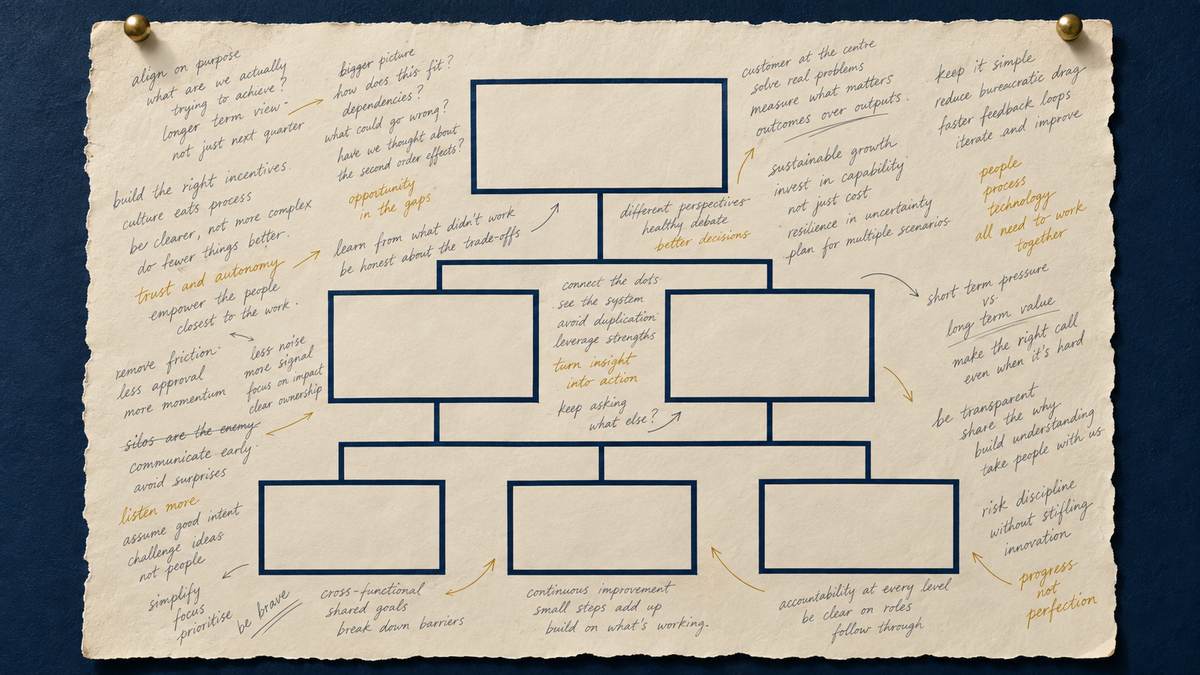
You can draw up an org chart, but when you draw org charts, there's always white space in between all these boxes. And you have to, as a team, come together and close that.
Daniel Gandarilla
Daniel Gandarilla holds a bachelor’s degree, two master’s degrees and a doctorate, which is where Glenn Llopis started: what fuels that much curiosity? The answer was his parents, who had less opportunity to finish school themselves and made sure their children would. He credits his father for the standard and his mother, with affection, for making certain it actually happened.
At the time of the conversation he was senior vice president and chief human resources officer for executive services at Advocate Health, with responsibility for the whole executive lifecycle: recruiting, onboarding, compensation, development and offboarding.
Glenn asked about his cultural background. His family comes from northern Mexico, and he spent a year living in Mexico City.
"I was born in the United States, but I thought it was important to get connected to my roots." — Daniel Gandarilla · 00:02:31
"that's part of the immigrant perspective. We take the time to navigate and explore because we're in search of what's possible." — Glenn Llopis · 00:03:00
It is a small exchange that explains a lot of what follows. The person who went looking for where he came from is the same person now asking executives to leave the role they were handed.
Advocate Health was then a new combination of Atrium Health in the southeast and Advocate Aurora in the Midwest. Gandarilla describes aligned missions and good timing, and then the real work: finding out how the two are the same and how they differ, down to how people in different parts of the country set goals and talk to each other.
His team’s short-term answer was to start working together and figure it out while working, while the human resources function laid out its own strategy. They took the organization’s public commitments, worked out what those would require internally, and brought that back to the business leaders: new kinds of roles, new mindsets, new ways of convening people. The hardest part, he says, is not the plan. It is that every individual has to move for the plan to work.
Glenn raised something he keeps seeing: a person has held a role for ten or twenty years and assumes the role is therefore fixed. Gandarilla agreed without hesitation.
"A role needs to evolve, and if you're doing the same thing for 10 years consistently, that tells you there's not a lot of evolution and change in the work that's being done." — Daniel Gandarilla · 00:12:37
Redesigning the organization meant re-examining what each job was, and he is candid that not everybody liked it. Glenn called that healthy tension, and said it is where the work actually begins. What Gandarilla took from his own organization is the idea in the line at the top of this page, that the gaps between the boxes are a shared responsibility rather than a hierarchy problem.
"sometimes you end up playing a role that may not necessarily be in a job description, but sometimes you have to do that before to let it evolve." — Daniel Gandarilla · 00:13:38
"...at least from our generation, we've been conditioned to fit in a box ... preparing people not only to reinvent the box that they're in, but play outside of it" — Glenn Llopis · 00:15:11
The executive center he leads exists to personalize the executive lifecycle. In recruiting, he is looking for a quality that is easy to say and hard to assess:
"number one is this person has to be a good cultural navigator to understand how things were done in both sides and to bring people together" — Daniel Gandarilla · 00:16:50
Efficiency still matters, he says, but he also needs leaders who see the work through the organization’s purpose, including using the organization as a route to meaningful employment and sustainable wages in communities that have been underserved.
In onboarding, the work is unglamorous and specific. Close the requisition and the handoff has already begun. Arrange system access before the first day. Count the clicks it takes to do something and reduce them. Convene new leaders with colleagues from both legacy organizations and let the different perspectives rub against each other, because that is where something new comes out. One of his own examples is a compliance requirement that a team replaced with a day spent together, which produced better conversations than the standard version would have.
"To me, that's the whole goal here is if we can get closer to you needed this and we got you. Not the stock thing that everybody gets, but something more tailored" — Daniel Gandarilla · 00:24:43
The gaps between the boxes. Gandarilla told Glenn Llopis that no chart covers all the work, so a team has to come together and close those gaps rather than treating them as someone else problem in the hierarchy.
Because it says the work itself has not evolved. Gandarilla told Glenn Llopis that roles need to evolve, and that redesigning them is uncomfortable but necessary, especially when two organizations combine.
Services wrapped around the person from the moment of hire: early system access, fewer clicks, deliberate introductions across both legacy organizations. Gandarilla told Glenn Llopis the goal is something tailored rather than the stock package everybody gets.
Glenn Llopis is The Identity Catalyst. For more than twenty years he has helped leaders and organizations reclaim the identity they edited away and lead from earned conviction. He is a Forbes contributor, the author of six books, and the founder of Glenn Llopis Group.
Read Glenn's story →© 2026 Glenn Llopis. All rights reserved.
This page is the original work of Glenn Llopis and is protected by copyright. Quotations are drawn from a recorded conversation and are attributed to the speaker. The page may not be republished, reproduced, distributed or adapted, in whole or in part, in print, online or by AI tools, without prior written consent. You are welcome to share the link or quote a brief excerpt with credit to Glenn Llopis and a link back to this page. Guests featured here are welcome to share and excerpt their own interview. For permission requests, contact solutions@glennllopisgroup.com.
Take the Conviction Diagnostic. In three minutes, see where you've traded who you are for who the room wanted, and exactly where to begin reclaiming it.

His story starts where reinvention did: a family that left everything behind for a new country and refused to call it loss. Cuban Roots →
.svg)
.svg)
.svg)
.svg)
.svg)
.svg)
