Opportunity
·
Career Growth
A System Can Read Your File. Only a Person Can See You.
The WSJ tells the story of a Princeton Ph.D. who has applied to more than 2,300 jobs without an offer. The economics explain part of it. The rest is a hiring system built to compare files, where almost no one ever meets the person.
What the Headlines Miss · Responding to
A Princeton Ph.D. Applied to 2,300 Jobs. He Still Can't Get One.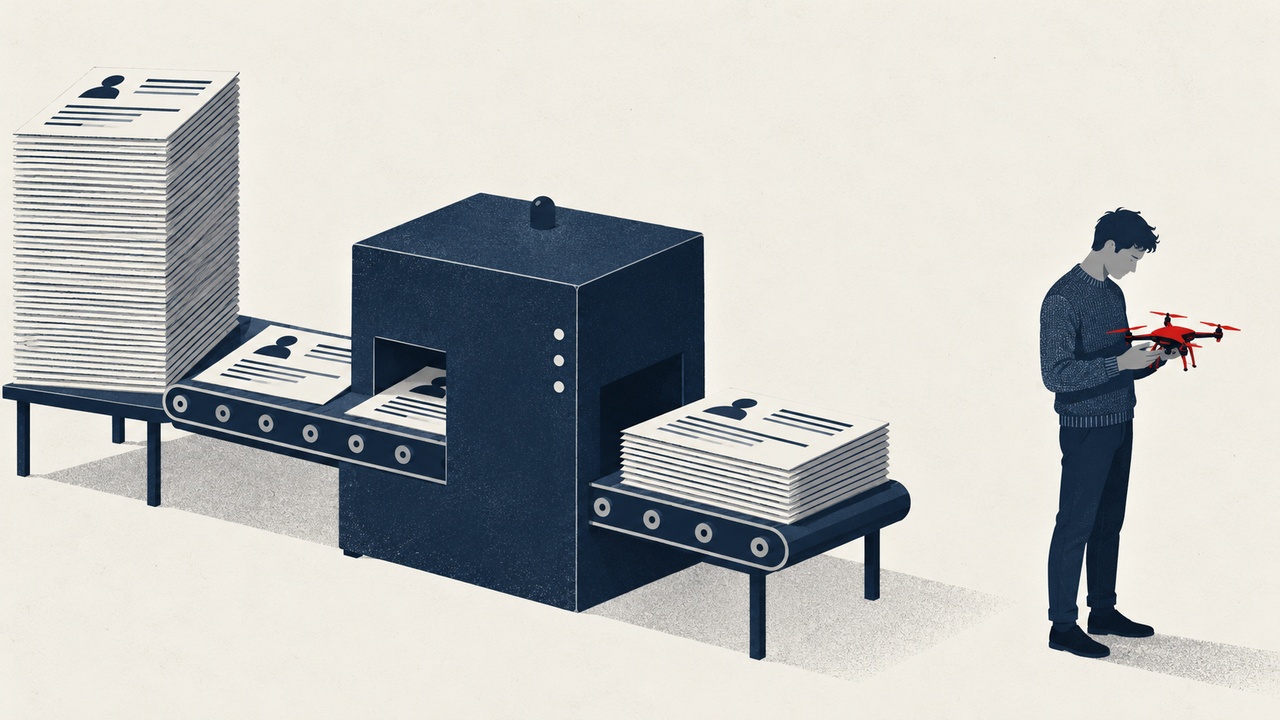
In The Wall Street Journal, Lindsay Ellis tells the story of Jack Weis in A Princeton Ph.D. Applied to 2,300 Jobs. He Still Can't Get One. Weis finished his doctorate in chemical engineering in 2024 after graduating summa cum laude from Rice. His research on ice formation was cited by the Nobel committee. Since then he has applied to more than 2,300 jobs, from national laboratories to food preparation roles, and he is still looking. Ellis uses his story to explain a labor market where many people hold on to their jobs and those on the outside can't find a way in.
Ellis lays out the economics well. But the detail that stayed with me wasn't the number of applications. It was how rarely anyone in the process actually met him.
A Hiring System Built to Read Files
Look at the path his candidacy took. Online portals. Automated screening. One-way video interviews where he recorded answers for software to evaluate. He is far from alone in that: a Greenhouse survey of 2,950 active job seekers found that 63% had been interviewed by an AI.
Even the human doors led back to the machine. Princeton alumni took his calls, Ellis reports, and then pointed him to their companies' job websites. One application he submitted in 2024 sat unreviewed for two years until the role was quietly filled.
I understand why employers built this. When hundreds of applications arrive for every opening, many written with AI, a consistent process is the fairest way to sort them. It gives every applicant the same first look, and that has real value.
The trouble starts when the first look becomes the only look. A system designed to compare files gets very good at comparing files. It can confirm that a résumé has the right degree, the right keywords and the right years of experience. It can't tell you what a person naturally solves for, how they think when a problem has no template, or what they would build if someone gave them room. Those are the things that make a candidate valuable, and they rarely show up in a file.
When the Expertise Gets Rented Out
There is a painful irony in the middle of the story. For a while, Weis earned money training AI on his own expertise in engineering and fluid mechanics, writing questions for a model and grading its answers. Then the work dried up. His knowledge was valuable enough to teach a machine, but the hiring systems around him still couldn't see the person who held it.
I wrote about this distinction in AI Can Learn Your Expertise. It Can't Learn Who You Are. Expertise can be captured and transferred. Identity can't. What you notice, what you care about and how you connect ideas no one else would connect are yours alone. But that only becomes an advantage when someone, somewhere, is close enough to see it.
From Waiting to Be Chosen to Choosing
The most hopeful part of the article comes near the end. Weis has signed up for the LSAT. He used AI to design a drone that targets an invasive weed. He is trying his hand at building something of his own. As he puts it, "If I truly believe I have some value, I should go out and get it."
That line describes a shift I see in many talented professionals who have been stuck. For years they were taught that opportunity comes through selection: get the credential, submit the application, wait to be chosen. When the selection system stalls, they assume the problem is them. Often the better move is to stop waiting for a gatekeeper to recognize their value and start putting it to work where people can see it.
None of that excuses a hiring market that has stopped meeting people. But it puts some control back in the individual's hands.
What Each Side Can Do Now
For leaders who hire, a few questions are worth asking this week.
At what point in your process does a human being first talk with a candidate, and how many good people are filtered out before that moment?
When an alumnus, employee or friend vouches for someone, does your system have a way to act on it, or does it send them back to the portal?
What would you learn from asking candidates to show you a problem they solved on their own, rather than proving they match a list?
For professionals on the outside, the questions are different. What problem do you keep coming back to, whether or not anyone pays you for it? Who could see that work if you made it visible? And which relationships could you invest in by helping first, without asking for a job? I explored why being known matters so much in Where You Work Matters Less Than Who Knows You There.
Weis's credentials got him everywhere except in front of the people who make decisions. His story should push employers to look for the person behind the file, and remind job seekers that their value doesn't wait for permission.
A system can read your file in seconds. Only a person can recognize who you are, so make sure someone gets the chance.
Want to explore these ideas further? Learn more about my work on leadership, identity and conviction at www.theglennllopis.com.
A system can read your file in seconds. Only a person can recognize who you are, so make sure someone gets the chance.
© 2026 Glenn Llopis Group, LLC. All rights reserved.
This article is the original work of Glenn Llopis and is protected by copyright. It may not be republished, reproduced, distributed or adapted, in whole or in part, in print, online or by AI tools, without prior written consent. You are welcome to share the link or quote a brief excerpt with credit to Glenn Llopis and a link back to this page. For permission requests, contact solutions@glennllopisgroup.com.
Get the next essay in your inbox
New essays on leadership, identity and conviction, sent to you when they publish. Free, and you can unsubscribe anytime.
Thank you. You're subscribed to Conviction Chronicles.
Something went wrong. Please try again.