.svg)
Conviction
·
Transformation
AI Can Learn Your Expertise. It Can't Learn Who You Are.
60 Minutes asked whether AI will take our jobs. The better question is what AI can't learn from us, and whether leaders will protect the places where people earn it.
What the Headlines Miss · Responding to
AI is being taught how to do your job. Will artificial intelligence replace us, or just change the way we work?
On October 4, 2026, 60 Minutes asked the question sitting in the back of nearly every working mind: is this technological revolution like the others, or is the great job apocalypse finally here?
Jon Wertheim's report takes viewers inside Mercor, a San Francisco company that grew from about 20 people in January of last year to about 400 today. Mercor pays experts, more than 100,000 of them, to teach AI models what they know. A winemaker, a physician and a music producer describe spending their evenings grading AI's answers in their fields. The company's 23-year-old CEO, Brendan Foody, believes he is creating a new category of work. Daron Acemoglu, the Nobel Prize-winning MIT economist, believes we are moving far faster than any workforce can absorb.
The segment frames the debate as optimism versus alarm, and both sides are arguing about the number of jobs. The harder questions sit underneath the numbers: what is actually being handed over, what is being lost along the way and who gets to decide what happens next.
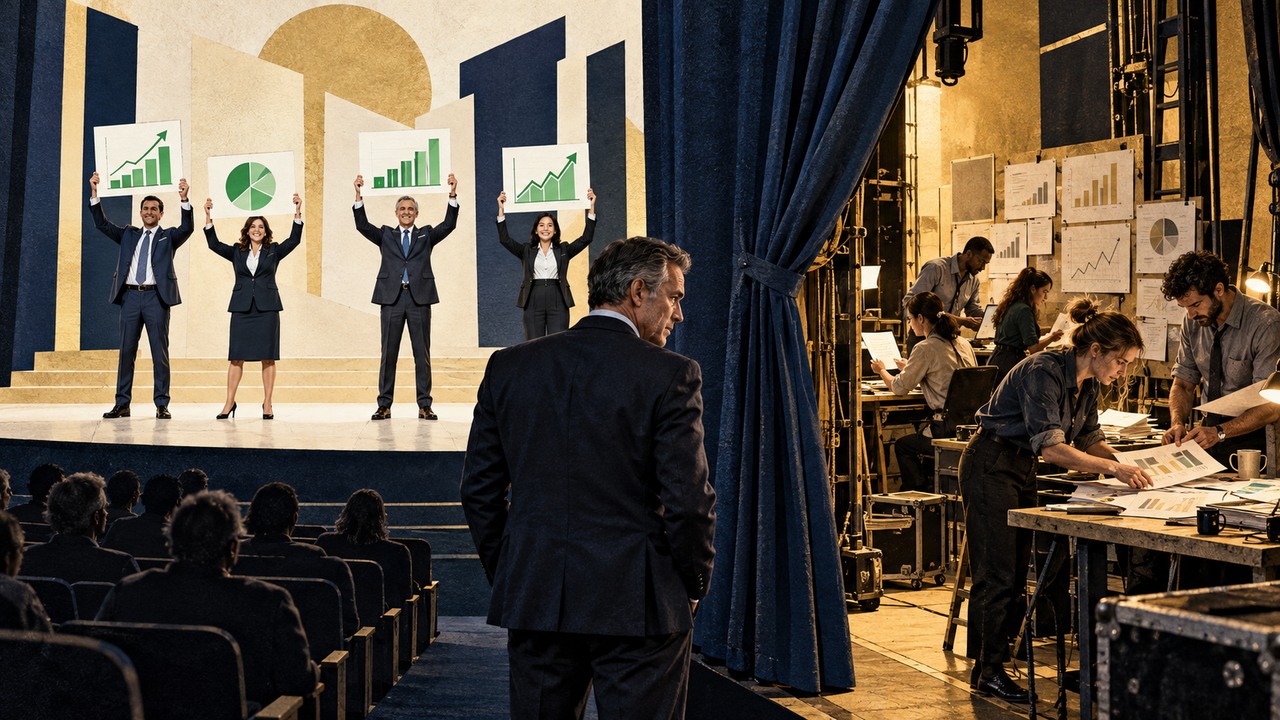
AI is learning the standard. The person is the personalization.
Watch what the Mercor experts are actually doing. They compare two versions of a lyric. They check whether a model reads a lab result correctly. They are teaching AI the repeatable patterns of their craft: what good looks like, what usually works and what an expert would flag.
Every serious craft runs on that kind of shared standard. It's why a patient gets the same careful read of a lab result in any good clinic, and why a winery's best bottle tastes like itself year after year. Consistency is how a profession earns trust. So if AI can learn the standard parts of a craft, nothing precious has been lost. It can raise the floor for everyone who uses it.
But every profession has a second layer that doesn't transfer the same way. Robbie Hiser, the music producer, put it simply: "AI doesn't have any life experience to pull from."
Kim Herlihy, a trial lawyer and partner at Vorys, Sater, Seymour and Pease in Columbus, Ohio, already works alongside an AI version of herself. Her firm built AI personas of its senior lawyers with Stanford, and hers reviews her draft opening statements and tells her when the phrasing is too stiff. Yet she is clear about why clients call her. They want to look their lawyer in the eye and ask what they should do.
That second layer is personalization: identity, lived experience and judgment applied to this person, this room and this moment. AI can learn how Kim Herlihy thinks. It cannot learn why she cares, what she has lived through or what she is willing to stand behind when the outcome is uncertain. That part is conviction. No dataset holds it, because it has to be earned.
The leaders who get this right will not treat it as a contest between humans and machines. They will find the harmony: let AI carry more of the standard, and give people more room to bring what is personal.
The hidden casualty is the first rung
Here is the part of the story that should worry every leader more than any headline number.
The segment notes that the early pain is landing on people in their twenties, in the jobs most exposed to AI. Clara Shih, who led AI divisions at Salesforce and then Meta, explained why. The tasks we traditionally hand to young people, research and first drafts, are exactly what AI now does well. She has watched work that once required dozens of people get done by two or three people using AI agents.
On a spreadsheet, that looks like efficiency. In a career, it looks like a missing rung.
Those first drafts were never just cheap labor. They were reps. Every rough memo a senior partner marked up, and every analysis a manager sent back, was a young professional earning judgment one correction at a time. That is how a junior associate becomes a Kim Herlihy. Her AI persona is valuable precisely because she spent a career earning the judgment it imitates.
So ask the uncomfortable question. If AI takes the reps, where does the next generation of experts come from? Who will be worth training the models on 15 years from now?
I wrote recently that confidence is leaving through the entry level. This is the mechanism. Young people aren't only losing jobs. They are losing the places where conviction used to be earned.
Job loss is identity loss
Clara Shih named something that cuts deeper than any unemployment forecast. When people lose their jobs, she said, it's never just about the jobs. It's their sense of self-worth and the fracturing of communities. She saw it growing up in Ohio, where her family arrived from Hong Kong in the 1980s as globalization hollowed out factories and neighborhoods.
She is right, and it tells us where the real vulnerability lives. When someone's identity is fused to a task, losing the task feels like losing themselves. When someone knows what they solve for, the problem they are uniquely suited to solve no matter the tools, a changed job becomes a reinvention rather than an erasure.
The songwriter, the winemaker and the physician have something in common. They know who they are in their work, which is why they can teach AI their craft without feeling they are giving themselves away. Most workers have never been invited to answer that question, and what AI can't copy is often what people stopped saying about themselves long ago. That is a leadership gap we can still close.
The pace is the problem, and the choice is ours
Acemoglu's warning is about speed. The first phase of the Industrial Revolution unfolded over about 80 years. He says this transformation is happening in one or two years, across many sectors at the same time. In his worst case, if we do nothing and stay on our current course, unemployment could triple within a decade. He also rejected the idea that AI training jobs will absorb the displacement, because the number of trainers is small compared with the number of people automation will replace.
The public is feeling it. Pew Research Center findings cited by 60 Minutes show nearly three-fourths of Americans now fear AI is coming for their jobs. AI training is LinkedIn's fourth-fastest-growing job category in America, yet many Mercor trainers told 60 Minutes the work comes unpredictably, at $20 to $200 an hour, and is no substitute for a full-time job with benefits.
And yet Acemoglu ends on agency. Because the future is so uncertain, it is subject to our choices. He calls for AI designed to make people better rather than expendable. That is the conversation leaders should be having, because leaders are the ones making the choices.
What leaders can do now
- Protect the reps. Redesign entry-level roles so AI does the first pass and young people do the second: critique, verify, defend and improve. Make show me what you would change and why part of every review. The goal is not less work for early-career people. It is a faster path to judgment.
- Separate the standard from the personal in every role. Ask which parts of each job should be standardized with AI and which depend on the person. Invest in the second as deliberately as you automate the first.
- Measure growth, not just output. If AI makes a team more productive, ask what the people on it are learning. Efficiency that hollows out your bench is a loan against your future leadership, and the people the AI efficiency calculation leaves out are often the ones holding the judgment.
- Tell the truth. Shih's first lesson is to be honest with people about the risks. People can handle hard news. What they can't handle is a story that keeps changing.
What individuals can do now
- Know what you solve for. Your job title can be automated. The problem you are known for solving travels with you.
- Decide what you think before the tool does. Use AI to sharpen your judgment, not to replace the moment your judgment forms.
- Claim your lived experience. The stories, mistakes and instincts that shaped you are the part of your expertise no model can be trained on. Name them, and put them to work.
The question behind the question
Everyone is asking whether AI will take our jobs. It's a fair question, and no one, including the experts in this report, can answer it with certainty.
The better question is one we can answer: what will we protect? AI can learn your expertise. It can't learn who you are, what you've lived or what you're willing to stand behind. Conviction is the earned capacity to act on what you believe before the outcome is certain. In an age when machines can learn almost anything we teach them, it may be the most human advantage we have, and the one leaders most need to make room for people to earn.
Want to explore these ideas further? Learn more about my work on leadership, identity and conviction at www.theglennllopis.com.
AI can learn how you work. It cannot learn who you are or what you are willing to stand behind.
© 2026 Glenn Llopis. All rights reserved.
This article is the original work of Glenn Llopis and is protected by copyright. It may not be republished, reproduced, distributed or adapted, in whole or in part, in print, online or by AI tools, without prior written consent. You are welcome to share the link or quote a brief excerpt with credit to Glenn Llopis and a link back to this page. For permission requests, contact solutions@glennllopisgroup.com.
Get the next essay in your inbox
New essays on leadership, identity and conviction, sent to you when they publish. Free, and you can unsubscribe anytime.
Thank you. You're subscribed to Conviction Chronicles.
Something went wrong. Please try again.


.svg)
.svg)
.svg)
.svg)
.svg)
.svg)
