
Opportunity
·
Self-Awareness
Teens Are Spending Their Days on Screens They Don't Even Enjoy
The 2026 Common Sense Media Census finds a typical teen spends about eight hours a day on entertainment screens. The quieter finding matters more: 65% of young people use AI in their free time, but only 11% of teen users enjoy it a lot. Habit is taking the place of discovery.
What the Headlines Miss · Responding to
The 2026 Common Sense Media Census: Tech and Media Use by Tweens and Teens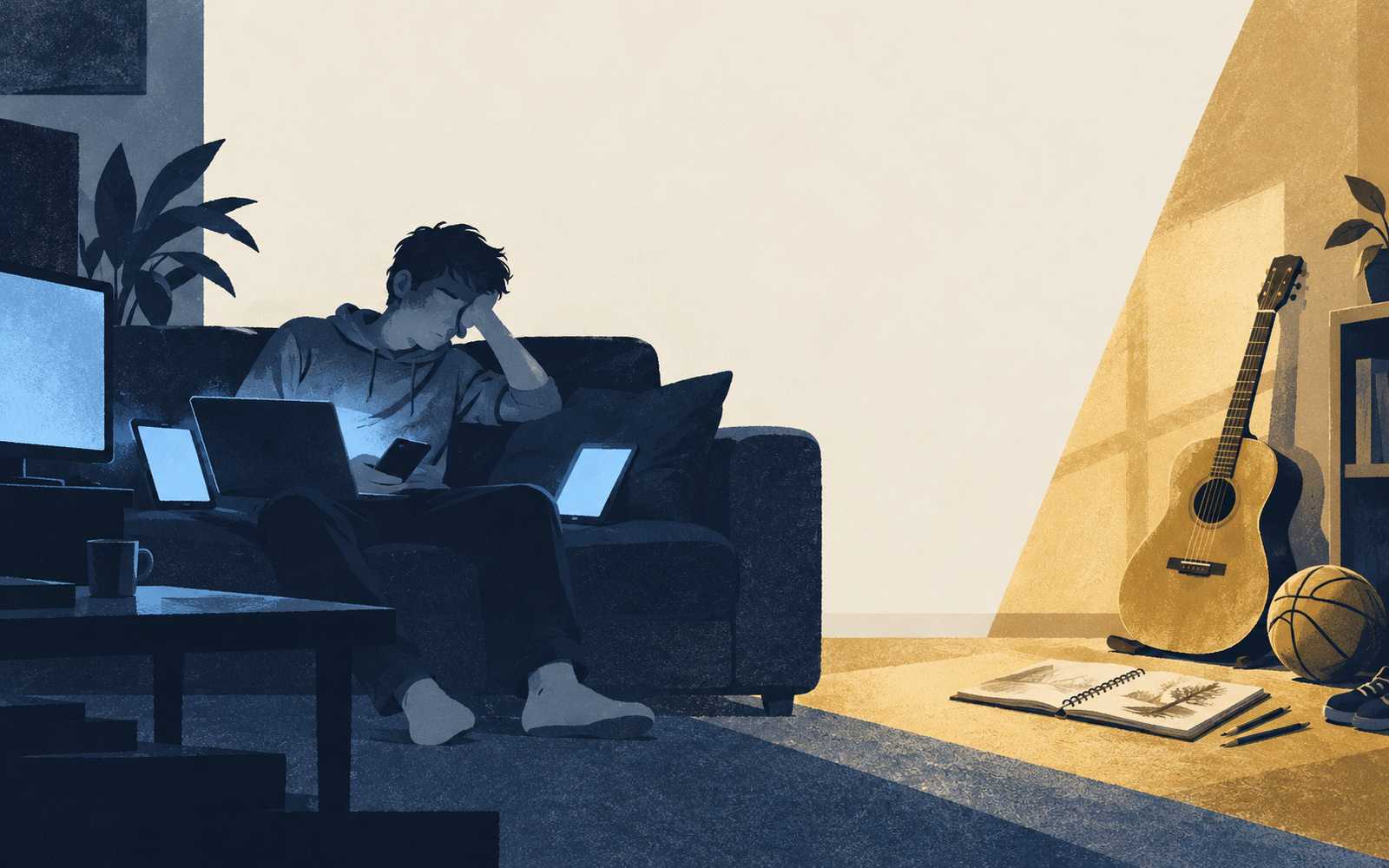
Common Sense Media has released its first full census of young people's media lives in five years. In The 2026 Common Sense Media Census: Tech and Media Use by Tweens and Teens, published October 27, the nonprofit surveyed a nationally representative group of 1,211 young Americans ages 9 to 17. For the first time, it measured AI alongside television, video, gaming and social media.
The headline numbers will get most of the attention. A typical teen spends about eight hours a day on screen media for entertainment, and a typical tween about five. More than 4 in 10 teens spend 10 hours or more. Smartphone ownership nearly doubles between ages 9 and 10 and passes the halfway mark by 11. Short-form video is now the most common daily activity the survey measured.
The Finding Beneath the Hours
The finding I keep returning to is quieter. Common Sense reports that across most kinds of media, far more young people use something than say they enjoy it a lot. The widest gap is AI. Sixty-five percent of the young people surveyed use it in their free time, but only 11% of teen users and 15% of tween users say they enjoy it a lot.
Read that slowly. A large share of a young person's free time is going to things they don't particularly like. That isn't a picture of kids chasing joy who need to be reined in. It is a picture of kids drifting, filling empty minutes because the screen is there and everyone else is on it.
That matters for more than wellbeing. Adolescence is when young people should be gathering evidence about themselves: what absorbs them, what bores them, what they would choose if no one were watching. Enjoyment is one of the most important signals in that search. When the hours go to things a teen doesn't even enjoy, the signal gets lost. Habit takes the place of discovery, and a young person can reach 18 without knowing what they would do with an afternoon that was truly theirs.
A Limit Only Creates Empty Time
Common Sense also found that tweens' and teens' days are so crowded with screen media that little time is left for anything else. The natural response is to cut the hours, and limits do help. Clear, consistent family rules give everyone the same expectations and take the nightly fight out of the house. Schools that set shared phone policies give students a break from the pressure to always be reachable.
But a limit only opens up time. What fills it is the more important question. If a teen doesn't know what they enjoy, an hour without a screen can feel like a punishment, and the phone wins again the moment the rule relaxes. I argued in The Best Screen-Time Limit Is a Future Self that the strongest reason to put a phone down is a picture of who you want to become. This new data points to a companion idea: the strongest pull away from a screen is something a young person loves doing.
That is also where the path to a career quietly begins. Long before anyone picks a major, they need to notice the kinds of problems they lose track of time solving. I made that case in Students Don't Need a Major First. They Need to Know What They Enjoy Solving. A teen who has never had the room to notice will struggle with one of the most important questions of their life.
Questions for Parents and Educators
Ask your teen to sort their screen time into three piles: things they love, things they're fine with and things they do out of habit. Don't judge the answers. Let them see the gap for themselves.
Watch for the moments when your child loses track of time doing something without a screen. Name what you see, then make room for more of it.
When you set a limit, pair it with an invitation. Instead of only announcing when phones go off, ask what they would like to try with that hour, and help them try it.
For parents of younger children: the Census shows phone ownership climbing fast around ages 10 and 11. Before that first phone arrives, talk with your child about what they already love doing offline and protect time for it, so the device joins a life rather than replacing one.
For educators: give students regular chances to choose a project based on their own interest, then ask what they noticed about themselves along the way.
The Census tells us how young people spend their time. The harder question is whether any of that time is teaching them who they are.
Young people discover who they are by noticing what they love, so protect the time and quiet that let them notice.
Want to explore these ideas further? Learn more about my work on leadership, identity and conviction at www.theglennllopis.com.
Young people discover who they are by noticing what they love, so protect the time and quiet that let them notice.
© 2026 Glenn Llopis Group, LLC. All rights reserved.
This article is the original work of Glenn Llopis and is protected by copyright. It may not be republished, reproduced, distributed or adapted, in whole or in part, in print, online or by AI tools, without prior written consent. You are welcome to share the link or quote a brief excerpt with credit to Glenn Llopis and a link back to this page. For permission requests, contact solutions@glennllopisgroup.com.
Get the next essay in your inbox
New essays on leadership, identity and conviction, sent to you when they publish. Free, and you can unsubscribe anytime.
Thank you. You're subscribed to Conviction Chronicles.
Something went wrong. Please try again.





