Opportunity
·
Opportunity
Let Them Wander: Exploration and a Teen's Good Days
A New York University-linked study tracked the phones of 58 people aged 13 to 27 for three months. On days they moved through more varied places, they also felt better. Here is what that means for parents weighing freedom against worry, including the part about risk.

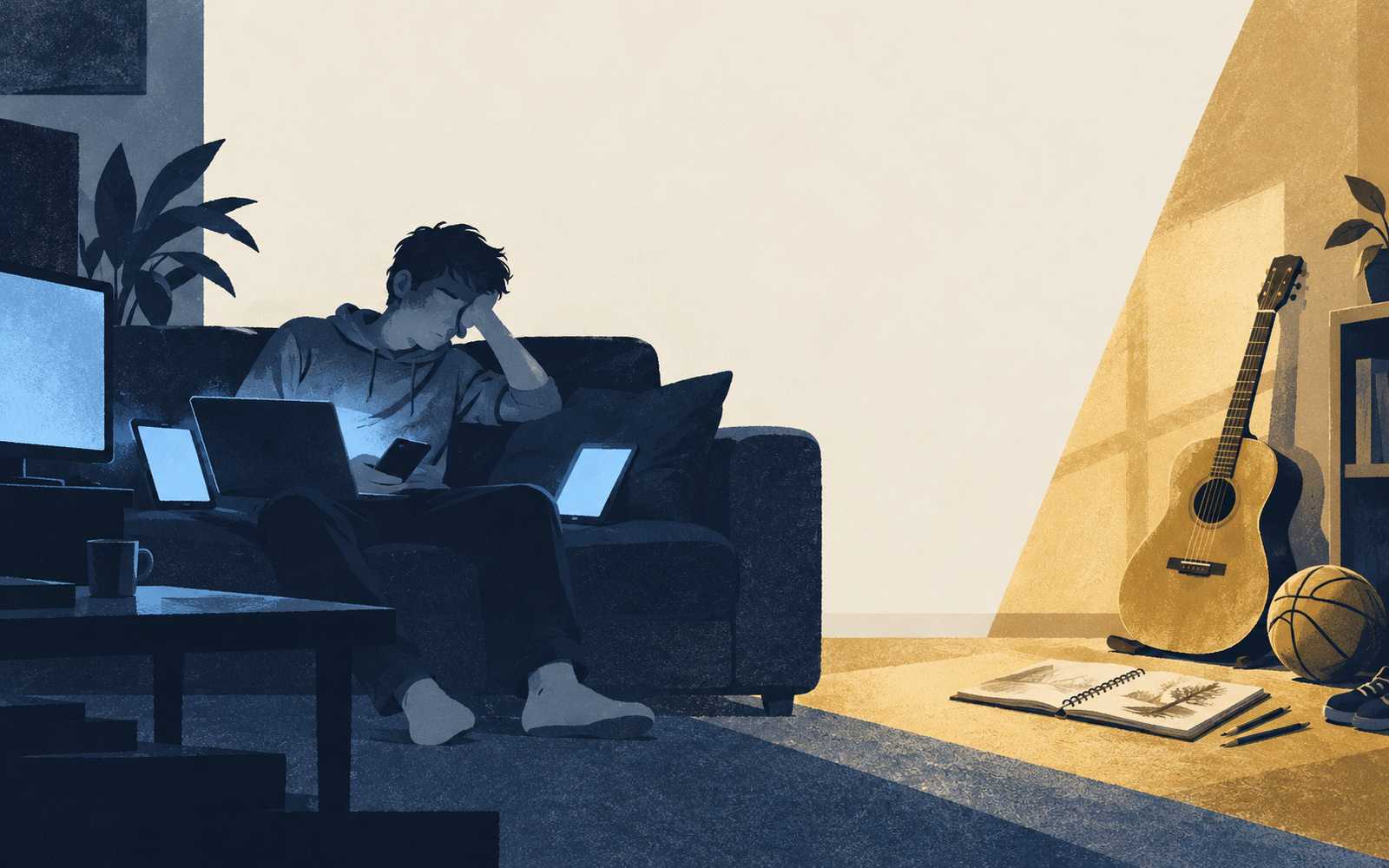
Ask a parent where their teenager was on a really good day, and the answer is rarely "in their room." It is usually somewhere a little unfamiliar. A new trail. A neighborhood they had never walked. A part of town they found with a friend and a bus pass.
Most of us file that kind of wandering under risk. Where are you going? Who will be there? Text me when you get there. Those questions come from love, and some of them are necessary. But a small and unusual study suggests we should also see the wandering itself for what it may be: part of what a good day is made of.
Three Months of Phones and Moods in New York City
A team led by Natalie Saragosa-Harris, with Alexandra Cohen and senior author Catherine Hartley of New York University, wanted to know how much young people actually explore in daily life and what that exploring goes with. Instead of asking people to remember where they had been, they used the location tracking on participants' phones. Over three months, they followed 58 adolescents and adults aged 13 to 27 in New York City, measuring exploration as how much each person's daily movement varied, and asking about their mood along the way. The paper appeared in Psychological Science in 2022.
Three findings stand out.
First, exploration rose across adolescence, and the people near the transition to legal adulthood explored the most. Wanting to go new places is a normal part of growing up, not a sign that something has gone wrong at home.
Second, mood. As the researchers wrote, "Days of higher exploration were associated with greater positive affect irrespective of age." In plain words, on days when people moved through more varied places, they also felt better, and that held for the youngest teens and the young adults alike.
Third, people who explored more overall also had more social connections, and that was true across the whole group. But higher exploration was also linked to more risk-taking, and only among the adolescents.
I want to be careful about what this study can and cannot tell us. It followed 58 people in one city, so it is small. It was observational: it tracked what people did and how they felt, and nobody was assigned to explore. A good mood might send someone out the door as easily as a new street might lift their mood. And the risk-taking finding is real. It belongs in the conversation, not in a footnote.
New Places Don't Come With a Label Attached
Here is why this study caught my attention. So much of a teenager's life happens in the same few rooms: the same hallway, the same lunch table, the same group chat, the same bedroom. Those rooms are full of expectations. Everyone already knows who you are supposed to be there, and a young person learns quickly to edit themselves to match.
A new place doesn't know any of that. Nobody at the climbing gym across town has decided your daughter is "the quiet one." Nobody at the community garden has filed your son under "the funny one." For a few hours, the question "Do they see me, or a label?" has an easier answer, because there is no label yet.
New places also show a teen things about themselves they could not have learned at home. What they notice first. What they want to go back to. Who they turn into when nobody expects anything in particular. Those clues are small, and they change as a teen grows, but they add up to an early answer to "What do people always come to you for?"
Cohen, who now leads a lab at Emory University, has written with Catherine Insel that adolescence is a time of active brain change, one that brings real shifts in how young people explore and make decisions. That framing matters to me. It treats the teen years as a stage with its own purpose rather than a deficit to manage, a point I made in "The Teen Brain Isn't Done Until 25" Is a Script, Not a Finding.
Freedom and Guardrails Can Grow Together
None of this means rules are the enemy. Every room in a teen's life needs its own mix of structure and freedom, and the mix for a 13-year-old exploring a city is different from the mix for a 19-year-old. The risk-taking link in this study is a good reason to keep some structure in place. It is not a reason to keep the map small.
Grow the radius on purpose. Agree on a range your teen can roam, and widen it as trust is earned. A bigger radius that has been earned teaches more than a big one handed over or a small one that never changes.
Ask a different question at dinner. Instead of "Where were you?" try "Where did you go today that was new?" The first question checks a box. The second tells your teen that new experiences are something you value.
Pair new places with people. Exploration went with more social connection in this study, so the trip to a new neighborhood with a cousin or a friend may carry more than the trip alone.
Keep a few non-negotiables simple and clear. Check-in times, how they will get home, who to call. Structure like that is what lets you say yes more often.
And go with them sometimes. Take a different route to the store. Spend a Saturday in a part of town neither of you knows. You may learn as much about your teen in an unfamiliar place as they learn about themselves.
As I wrote in Room to Roam Is Not Enough, freedom is only half of it. Young people also need room to be themselves. The two often arrive together, on the days a teen walks somewhere new and nobody is waiting to tell them who they are.
A young person who has seen more of the world has more to compare themselves against than the one room that is trying to define them.
Research cited
Saragosa-Harris, N. M., Cohen, A. O., Reneau, T. R., et al. (2022). Real-world exploration increases across adolescence and relates to affect, risk taking, and social connectivity. Psychological Science.
Insel, C., & Cohen, A. O. (2025). More than just a phase: Adolescence as a window into how the brain generates behavior. Current Directions in Psychological Science.
Want to explore these ideas further? Learn more about my work on leadership, identity and conviction at www.theglennllopis.com.
A young person who has seen more of the world has more to compare themselves against than the one room that is trying to define them.
© 2026 Glenn Llopis Group, LLC. All rights reserved.
This article is the original work of Glenn Llopis and is protected by copyright. It may not be republished, reproduced, distributed or adapted, in whole or in part, in print, online or by AI tools, without prior written consent. You are welcome to share the link or quote a brief excerpt with credit to Glenn Llopis and a link back to this page. For permission requests, contact solutions@glennllopisgroup.com.
Get the next essay in your inbox
New essays on leadership, identity and conviction, sent to you when they publish. Free, and you can unsubscribe anytime.
Thank you. You're subscribed to Conviction Chronicles.
Something went wrong. Please try again.