Individuality
·
Culture
Suspended for Small Things: What It Costs the Whole Classroom
When a student is sent home for talking back or breaking dress code, we assume the cost stays with that one kid. Research on 1,860 students suggests classrooms that lean on suspensions for minor infractions see lower achievement across the room. Here is what that means for parents.
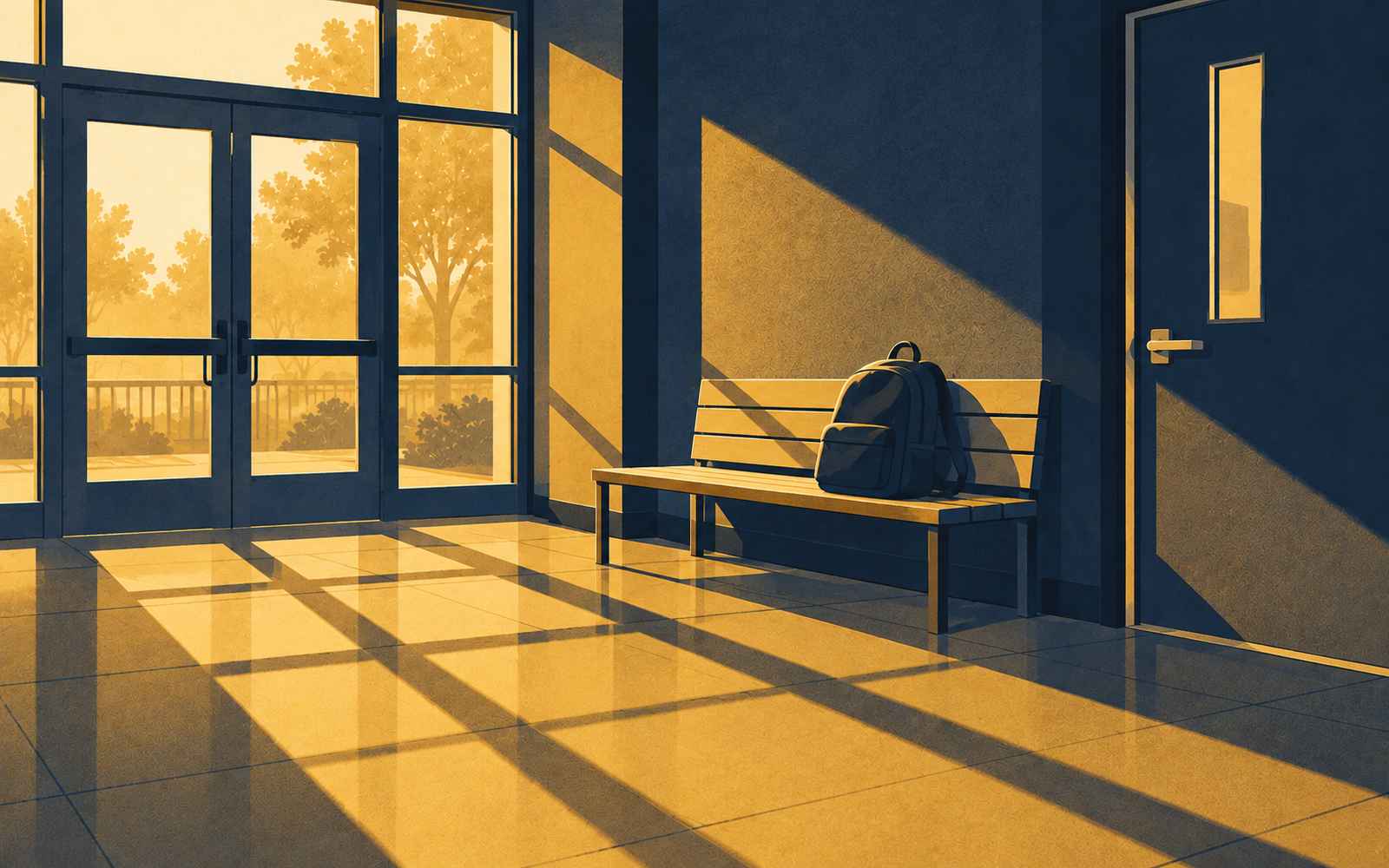
Picture a ninth grader who mutters something under her breath when a teacher calls her out. Or a seventh grader who keeps wearing a hoodie after being told twice to take it off. Neither is dangerous. Neither is a fight. In many schools, both can still end with a student sent home.
When that happens, most of us assume the cost lands on one kid. She misses a few days, falls a little behind, and the class moves on. A growing line of research suggests the class may not move on as cleanly as we think.
Two Studies, One Pattern Across the Room
Ming-Te Wang, now at the University of Chicago, led the research with Christina Scanlon and Juan Del Toro, now at the University of Minnesota. They looked at two groups of students aged 10 to 16: 558 students in 41 science classrooms and 1,302 students in 64 math classrooms. Their focus was suspensions for minor infractions, the kind of everyday misbehavior most adults would call normal for the age.
Two findings stood out. First, students who were suspended for minor infractions had lower achievement in both studies. Second, and more surprising, in classrooms that used these suspensions more often, all the students tended to have lower achievement, including the ones who were never suspended. Part of that link ran through engagement: in those classrooms, students were less engaged in learning overall.
This is observational research, so it can't tell us that suspensions caused the drop. Classrooms that suspend more may differ in other ways too. And there is a fair counterpoint. NaYoung Hwang and Thurston Domina studied one California district and found that classmates' suspensions went with slightly higher math scores for the other students, with no link for English. That bump seemed tied mostly to suspensions for serious, disruptive behavior rather than minor ones, and the authors could not fully separate the effect of removing a student from the effect of the misbehavior itself.
I don't read those two studies as a contradiction. I read them as a line. When a student is truly disrupting everyone's learning, removing them may protect the room. When the offense is small, the evidence from Wang's team suggests the room may pay a price instead. I should add that Wang also leads a federally funded project testing restorative approaches to discipline, so he has a professional stake in alternatives. That is worth knowing, and it doesn't change what the data showed.
What the Rest of the Class Learns
Why would one student's suspension touch everyone else? The research points to engagement, and I think there is a human reason underneath it.
Every consequence in a classroom teaches two lessons. One goes to the student who receives it. The other goes to everyone watching. When small things like a sharp comment, a dress code slip or a question asked the wrong way can get someone removed, the rest of the class draws a conclusion. It is safer to stay small. Don't push back. Don't stand out. Don't bring too much of yourself into this room.
That is how young people learn to edit themselves. Not from one dramatic moment, but from watching what happens to the kid who didn't. A teen in that room is quietly asking, "Can I be myself here?" and the answer they absorb is "only a careful version of myself." Careful students may look compliant. They are also less likely to raise a hand, offer an unusual idea or ask for help. That is the engagement the research measured.
I made a related argument in Belonging Isn't Fitting In. The Research Can Tell the Difference. A room that keeps order by making everyone smaller can look calm and still be losing the very thing school is for.
Rules Still Matter. So Does the Response.
None of this means schools should drop their rules. Teens need structure, and teachers need to be able to teach. A classroom with no limits is not a gift to anyone. The question is whether the response fits the behavior. Removal is a strong tool. Used for small things, it may teach the whole room the wrong lesson.
Teachers are under real pressure here, and I don't want to put this on them alone. As I wrote in Students and Educators Need Permission to Be Individuals, the adults in a school need room to use judgment too.
Where Parents Fit in This Conversation
If your teen is suspended for something minor, get the full story calmly before you react. Ask your teen what happened, then ask the school. Your goal is not to win. It is to understand.
Ask what the school's response is designed to teach. A conversation, a repair with the teacher or a short in-school consequence may keep your teen in the learning while still holding them accountable.
Talk with your teen about the rule itself. What is it protecting? Does it make sense to them? A teen who understands why a rule exists is more likely to keep it, and better able to disagree with it respectfully when they think it is wrong.
And if your teen is the one watching, not the one suspended, ask about that too. "How did the class feel after that?" can open a conversation about fairness, courage and what kind of room they want to be part of.
Schools will always need consequences. The ones that build strong students seem to save removal for what truly disrupts learning and handle the small stuff in ways that keep kids in the room, still speaking up and still trying.
Research cited
Wang, M.-T., Scanlon, C. L., & Del Toro, J. (2023). Does anyone benefit from exclusionary discipline? An exploration on the direct and vicarious links between suspensions for minor infraction and adolescents' academic achievement. American Psychologist.
Hwang, N., & Domina, T. (2020). Peer disruption and learning: Links between suspensions and the educational achievement of non-suspended students. Education Finance and Policy.
Want to explore these ideas further? Learn more about my work on leadership, identity and conviction at www.theglennllopis.com.
Every consequence teaches two lessons, one to the student who receives it and one to everyone watching.
© 2026 Glenn Llopis Group, LLC. All rights reserved.
This article is the original work of Glenn Llopis and is protected by copyright. It may not be republished, reproduced, distributed or adapted, in whole or in part, in print, online or by AI tools, without prior written consent. You are welcome to share the link or quote a brief excerpt with credit to Glenn Llopis and a link back to this page. For permission requests, contact solutions@glennllopisgroup.com.
Get the next essay in your inbox
New essays on leadership, identity and conviction, sent to you when they publish. Free, and you can unsubscribe anytime.
Thank you. You're subscribed to Conviction Chronicles.
Something went wrong. Please try again.