Conviction
·
Identity
Why Losing Likes Stings Teens More
When the likes drop, a teenager's mood can drop with them, and more than an adult's. A University of Amsterdam team found that pattern in Instagram data from 16,613 users and in a study of 194 people. Here is what it shows, what it doesn't, and how parents can respond.

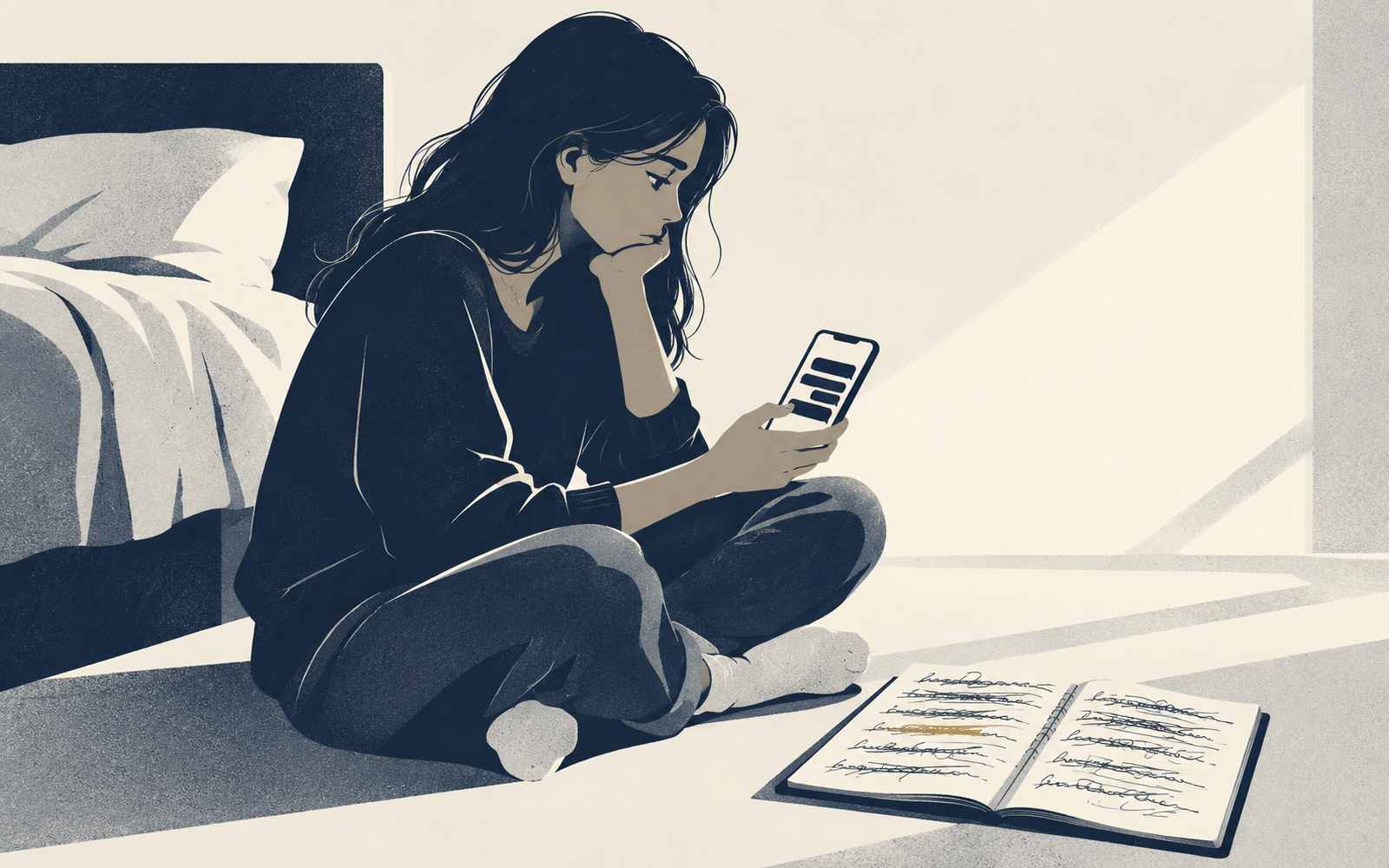
Picture a teenager who posts a photo they are proud of. Last time, it drew a wave of likes. This time, the number stalls. Nothing else has changed. Same friends, same school, same evening. And yet the night feels a little worse.
Most adults have felt some version of that. A new study suggests teenagers feel it more, and it offers a clearer reason why than "teens are obsessed with their phones."
What a Feed Full of Memes Revealed
A team at the University of Amsterdam led by Ana da Silva Pinho, with developmental scientist Wouter van den Bos as senior author, published three linked studies in Science Advances in 2024.
The first looked at an existing set of Instagram data covering 16,613 users and more than 1.6 million posts. Using a model of how people learn from rewards, the researchers found that adolescents' posting adjusted more to the likes they received than adults' did. Two cautions: the users' ages were estimated rather than reported, and the data dates from 2014 and 2015. The gap between age groups was also small.
The second study is the one that stays with me. The team recruited 194 people through Instagram, 92 aged 16 to 20 and 102 aged 30 to 40, and had them scroll through a feed and post memes. In the first round, their posts drew plenty of likes. In the second, the likes fell. Everyone rated their mood along the way. As the authors wrote, "adolescents' mood is affected more strongly by a reduction in likes than adults."
It is worth being precise about the design. Everyone went through the rounds in the same order, high likes first and then low, and the paper does not describe randomly assigning people to conditions. So this is a well-built test of what happens when likes drop, compared across two age groups, rather than a randomized trial. The mood changes were measured over minutes, not months, and the difference between teens and adults was modest.
A third study scanned the brains of 96 young adults aged 18 to 24 and linked sensitivity to feedback with the size of some deeper brain regions involved in emotion and reward. That part is exploratory, and the authors themselves say it does not show cause.
Likes Work Like a Lesson
The most useful idea in this paper, for parents, is the model behind it. The researchers treat likes as feedback that people learn from, the same way any of us adjust after a compliment or a cold silence. Teens, in this account, learn from that feedback faster.
That is different from saying teens simply copy whatever their friends do. In a separate study, Lieke Hofmans and van den Bos asked adolescents aged 12 to 18 and adults aged 22 to 45 to make estimates after seeing a peer's answer. The teens were actually less responsive than adults to how confident the peer seemed. That was a perception task, not a test of fitting in socially, so I hold it loosely. But together the two papers paint a more respectful picture of teenagers. They are not mindless followers. They are fast learners in a world that gives them constant, shifting grades.
And that is what worries me. When a teen learns quickly from likes, they are also learning what the room rewards. Post the funny version, the polished version, the version that worked last time. Over months, that becomes a way of editing themselves for an audience. I wrote about that pattern in Your Teen Isn't Just Scrolling. They're Managing an Audience.
In fairness, researchers disagree sharply about what social media does to teens overall. Jonathan Haidt and Jean Twenge see it as a major driver of worsening teen mental health. Candice Odgers, Amy Orben and Andrew Przybylski argue that average effects are small and that the case for cause is weak. This study doesn't settle that argument. It describes one specific, short-term mechanism, and it is worth knowing about whichever side you lean toward.
Be the Feedback That Holds Steady
Don't dismiss the sting. If a drop in likes hurts more at 16 than at 35, telling a teen "it's just an app" can sound like you don't understand. Acknowledge it first.
Remember who set the numbers. In the experiment, the researchers decided in advance how many likes each round would get. The count said nothing about the people posting. That is a useful story to share with a teen who is reading a slow night as a verdict.
Ask about the post, not the count. "What made you want to share that?" opens a conversation about what they care about. "How many likes did it get?" teaches them that the number is what matters.
Give specific, steady feedback at home. Likes swing. Your attention shouldn't. Tell your teen what you actually notice about them, and ask them, "What do you see in yourself that your friends don't?"
Make room for people who know them. A teen with a few relationships where they are known, not just accepted, has somewhere to stand when the number dips. That is the heart of Your Worth Is Not Your Follower Count.
A number that changes every hour can teach a young person what gets rewarded. Only the people who know them can help them learn what is worth keeping.
Research cited
da Silva Pinho, A., Céspedes Izquierdo, V., Lindström, B., & van den Bos, W. (2024). Youths' sensitivity to social media feedback: A computational account. Science Advances.
Hofmans, L., & van den Bos, W. (2025). Developmental differences in social information use under uncertainty: A neurocomputational approach. Developmental Cognitive Neuroscience.
Want to explore these ideas further? Learn more about my work on leadership, identity and conviction at www.theglennllopis.com.
A number that changes every hour can teach a young person what gets rewarded, but only the people who know them can teach them what is worth keeping.
© 2026 Glenn Llopis Group, LLC. All rights reserved.
This article is the original work of Glenn Llopis and is protected by copyright. It may not be republished, reproduced, distributed or adapted, in whole or in part, in print, online or by AI tools, without prior written consent. You are welcome to share the link or quote a brief excerpt with credit to Glenn Llopis and a link back to this page. For permission requests, contact solutions@glennllopisgroup.com.
Get the next essay in your inbox
New essays on leadership, identity and conviction, sent to you when they publish. Free, and you can unsubscribe anytime.
Thank you. You're subscribed to Conviction Chronicles.
Something went wrong. Please try again.