Individuality
·
Culture
"Doing School" Is Where Teens First Learn to Edit Themselves
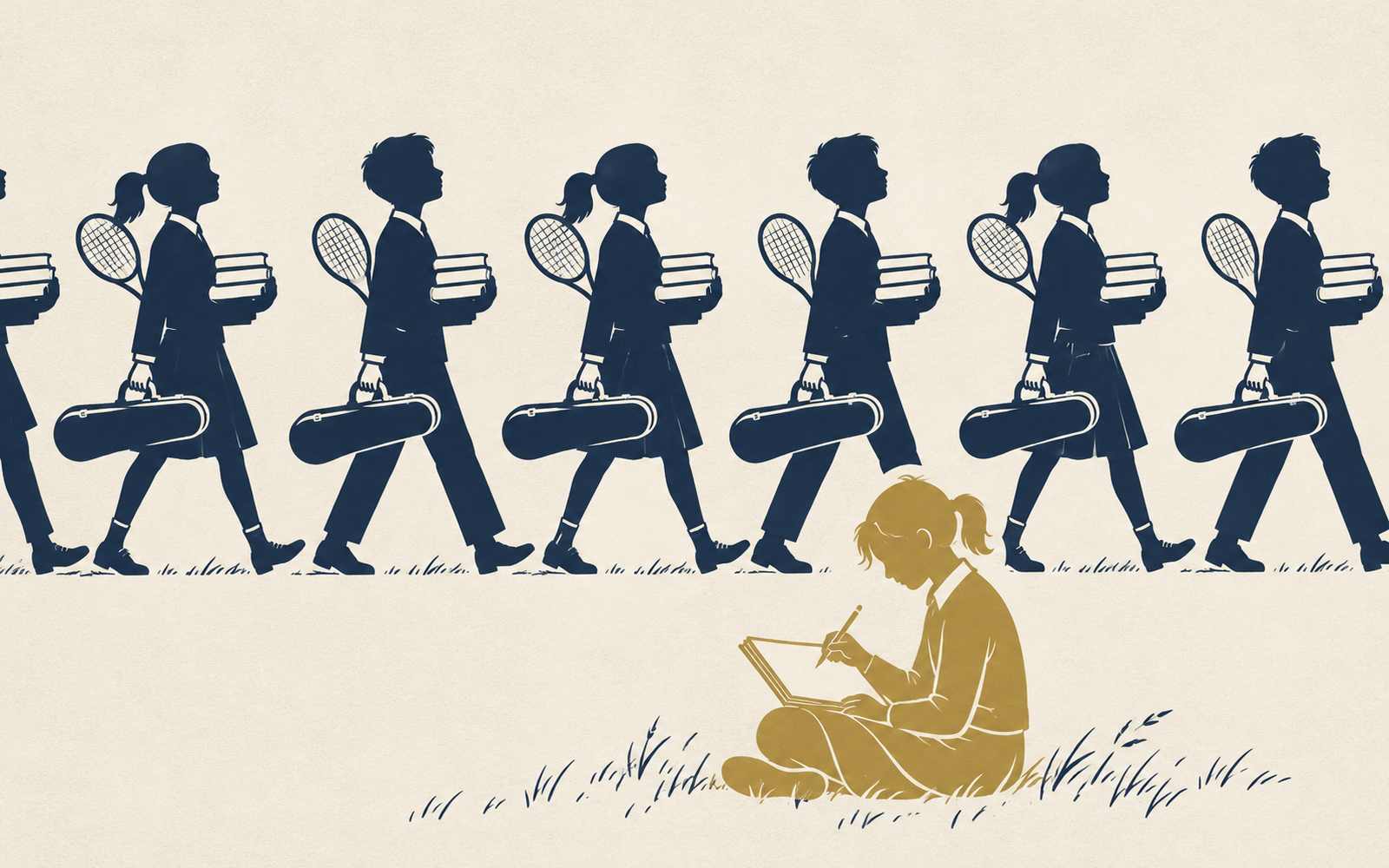
Nearly half of the high schoolers in one large survey had learned to succeed at school without really being in it. That is a smart response to a standardized room, and the evidence suggests the most useful fix starts with the room rather than the student.
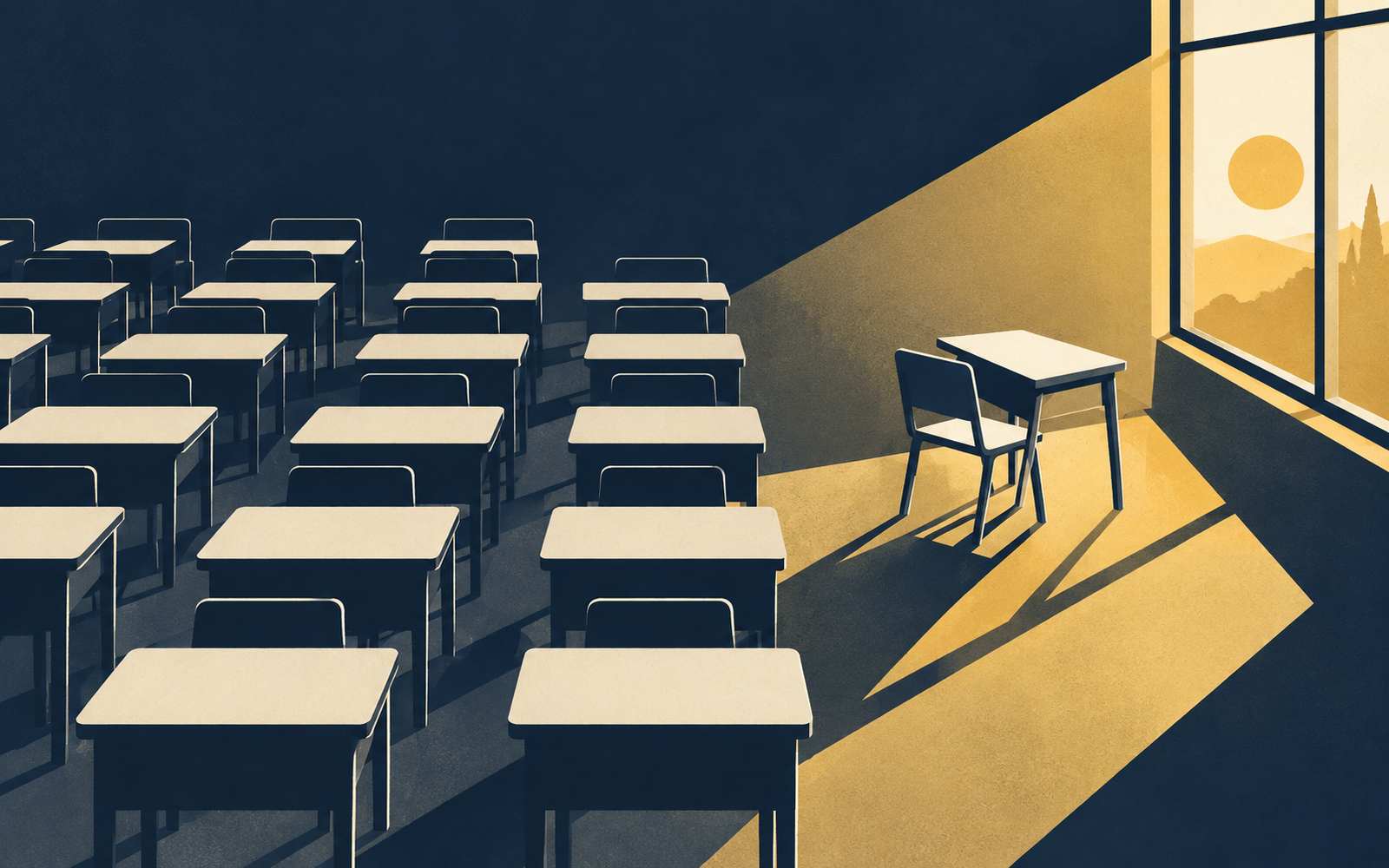
Nearly half of the high school students in one large survey had figured out how to succeed at school without really being in it.
Denise Pope, a senior lecturer at the Stanford Graduate School of Education and co-founder of the nonprofit Challenge Success, calls it "doing school." In a 2022 article in Phi Delta Kappan written with her Challenge Success colleague Sarah Miles, she described survey results from about 55,000 students at 73 U.S. public and private high schools, collected from 2018 to 2020. Some 48% fit the pattern of working hard for grades without finding meaning in the work. Only 13% were fully engaged in thought, feeling and effort all at once.
The same survey asked students to rate the statement "I can really be myself at this school." Just 42% said it was quite or completely true. Another 28% said it was not at all or only a little true.
Two cautions keep these numbers honest. The schools chose to work with Challenge Success, and they have tended to be well-resourced, high-pressure schools, so the sample does not represent all American teens. And the authors themselves say they can't tell whether belonging or engagement comes first, only that the two tend to go together.
A Smart Response to the Room
When I read about doing school, I don't see laziness or a generation that has stopped caring. I see bright young people adapting to what the room rewards.
If a classroom pays out for the expected answer, delivered on time in the expected format, a teen learns to supply it. They also learn which parts of themselves earn points and which parts don't, and they quietly set the second group aside. For many young people, that is the first time they edit who they are to fit a system. It works. Grades hold up. And the habit follows them into college, into their first job and into every meeting where they say what the room expects instead of what they see.
I want to be fair to schools here. Structure has a real job. Shared expectations, clear rules and common measures protect students and make learning possible at scale. The problem is not structure. It is a room where the same rules for everyone are the only thing that counts, and where the individual has nowhere to show up. Every classroom needs its own mix of structure and freedom, and finding it is a matter of harmony, not a fifty-fifty split. I made a similar case in Students and Educators Need Permission to Be Individuals.
Same Student, Different Classroom
If doing school were simply a trait some students carry, it would look the same in every class. The evidence suggests otherwise.
Camille Farrington and colleagues at the University of Chicago Consortium on School Research surveyed 8,318 students in grades 6 to 12 at 25 schools and compared each student with themselves across two core classes. Students earned higher grades in the class where they reported a stronger sense of belonging. The researchers called the relationships "small, but reliable." Because the comparison is within the same student, it rules out fixed traits like general ability or effort, though it is still correlational. Classrooms and schools together accounted for about 20 percent of the variation in semester grades.
A later brief from the Consortium and the nonprofit PERTS, led by Sarah Gripshover with Farrington among its authors, adds a warning. Among more than 4,000 students in grades 8 to 12, conditions such as teacher caring and meaningful work tended to get worse from October to February unless schools worked to improve them. Rooms drift, and a room nobody tends can slide toward compliance.
Amanda Vite and Erika Patall of the University of Southern California, with Man Chen, add a wider view. In a 2024 meta-analysis, students who felt their need for autonomy was met reported greater well-being, a correlation of .37 across 74 studies of K-12 youth. The link did not differ by school level, so it held for high schoolers as much as younger children. Patall's broader work also argues that autonomy and structure work together, which is exactly the harmony I want schools to find.
Fix the Room First
For educators, start by measuring the room, not just the student. Ask students where in your class they feel they can be themselves, and where they feel they have to perform. Their answers are data.
Offer one real choice in each unit: a question to pursue, a format to show what they know, a problem they pick. Small choices tell a student their judgment is welcome.
For parents, ask your teen which class makes them feel most like themselves, and which one makes them feel like they are playing a part. Then ask what the difference is. You will learn more about your teen from that answer than from any report card. These conversations sit at the center of my work with teens and parents through Teens UnEdited, and they echo what I wrote in Human Skills Can't Be Taught Without Room to Be Human.
A teen who is rewarded only for the right answer learns to hide the real one, so give them rooms where the real one counts.
If nearly half of our students have learned to do school, they have learned exactly what we taught them. The adults who run the rooms can teach something different, starting this semester.
Research cited
Pope, D. C., & Miles, S. (2022). A caring climate that promotes belonging and engagement. Phi Delta Kappan.
Farrington, C. A., Porter, S., & Klugman, J. (2019). Do classroom environments matter for noncognitive aspects of student performance and students' course grades? University of Chicago Consortium on School Research (working paper).
Gripshover, S., Londerée, A., Ahuvia, I., et al. (2022). Learning conditions are an actionable, early indicator of math learning. University of Chicago Consortium on School Research and PERTS.
Vite, A., Patall, E. A., & Chen, M. (2024). Relationships between experiences of autonomy and well(ill)-being for K-12 youth: A meta-analysis. Educational Psychology Review.
Want to explore these ideas further? Learn more about my work on leadership, identity and conviction at www.theglennllopis.com.
A teen who is rewarded only for the right answer learns to hide the real one, so give them rooms where the real one counts.
© 2026 Glenn Llopis Group, LLC. All rights reserved.
This article is the original work of Glenn Llopis and is protected by copyright. It may not be republished, reproduced, distributed or adapted, in whole or in part, in print, online or by AI tools, without prior written consent. You are welcome to share the link or quote a brief excerpt with credit to Glenn Llopis and a link back to this page. For permission requests, contact solutions@glennllopisgroup.com.
Get the next essay in your inbox
New essays on leadership, identity and conviction, sent to you when they publish. Free, and you can unsubscribe anytime.
Thank you. You're subscribed to Conviction Chronicles.
Something went wrong. Please try again.