Individuality
·
Self-Awareness
Every Family Can Afford the Same Script Now. That's the Problem.
The Economist shows intensive parenting spreading to families at every income level, with youth sports spending up 46% in five years. The deeper cost is not financial. When every family follows the same script, the qualities that help a child discover who they are get squeezed out.
What the Headlines Miss · Responding to
Intensive parenting is no longer the preserve of the rich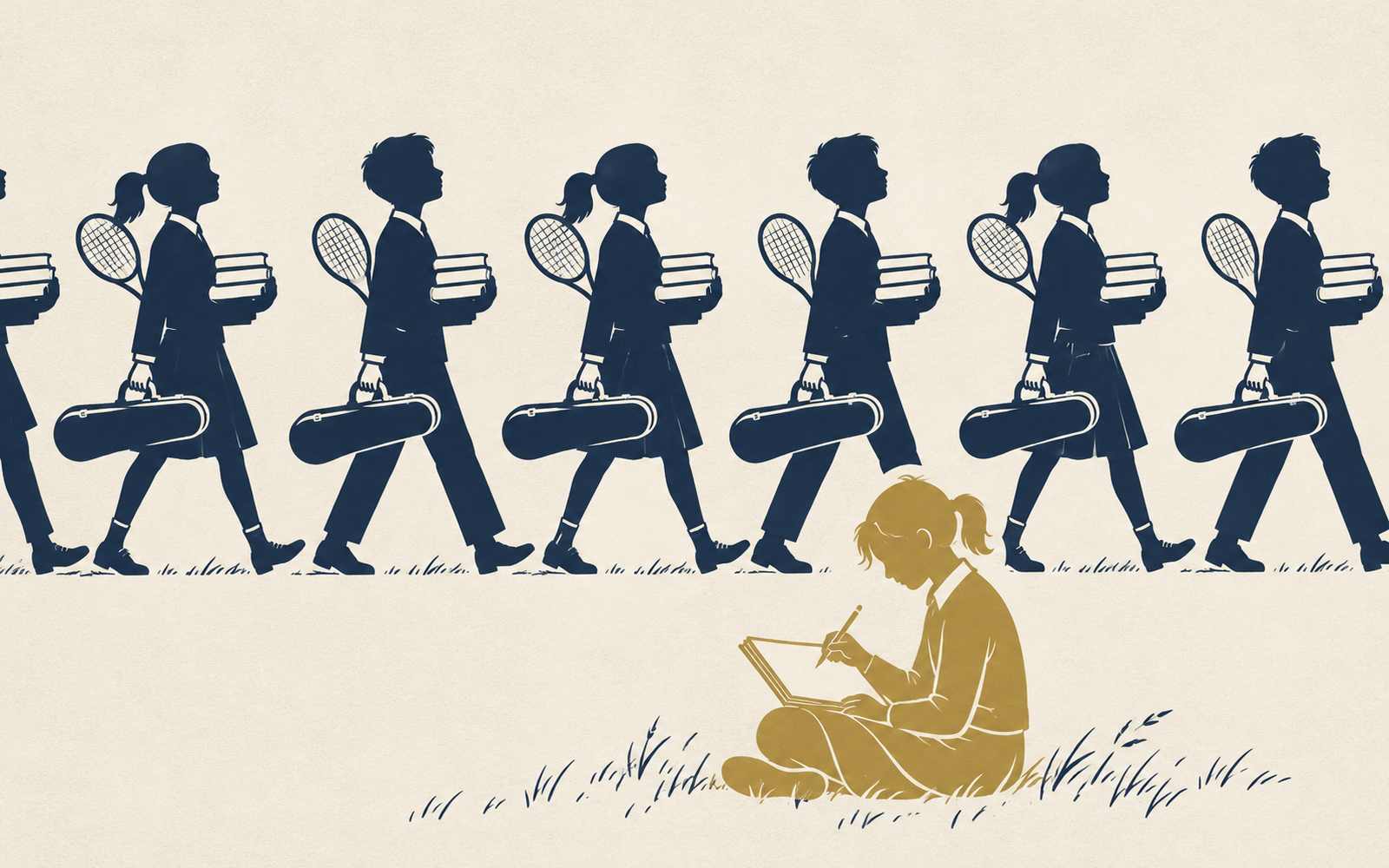
The Economist this week documents a shift many parents will recognize in their own calendars and bank accounts. In Intensive parenting is no longer the preserve of the rich, the paper shows how families across income levels are now paying for tutoring, coaching and lessons earlier and more aggressively, as competition for top universities and good jobs heats up. What was once a habit of wealthy households has become the norm almost everywhere.
The numbers are striking. The average American sports family spent $1,016 on one child's primary sport in 2024, a 46% increase since 2019 and twice the rate of inflation, according to the Aspen Institute's national youth sports parent survey. The Economist also finds the payoff uncertain. Social mobility has stalled in several countries, and the article's conclusion is blunt: when everyone spends more, wealthy families still come out ahead.
The Race Now Has a Script
The Economist treats this as a story about money and mobility. I see something underneath it that matters even more for the young people at the center of it. Intensive parenting has become a script, and now nearly every family can afford to follow it.
The script is familiar. Start early. Pick the sport, the instrument, the tutor. Stack the activities that look good on an application. Keep the calendar full. Parents follow it out of love and worry in equal measure, because the stakes feel high and the path feels narrow. Almost no one stops to ask whether the script fits the child who is living it.
One finding in the article deserves more attention than it gets. Economists Matthias Doepke and Fabrizio Zilibotti have shown that in more unequal societies, parents place less value on imagination and independence and more on hard work and obedience. In other words, the more anxious we become about our children's futures, the less room we leave for the very qualities that help them discover who they are.
Hard work matters. Structure matters. A disciplined practice schedule, a good coach and a clear plan for the school year are real gifts to a child. The trouble starts when the structure becomes the whole experience, and a teenager learns to perform a résumé before they have had the chance to find out what they actually enjoy solving. That is how young people learn to edit themselves. They become very good at becoming whatever the script rewards.
I wrote about a related idea in Don't Hand Your Child a New Checklist. Help Them Know Who They Are. Every generation of parents is handed a new checklist for success. The checklist changes. A child's need to be known does not.
When Everyone Buys the Same Advantage
There is a quiet irony in the Economist's data. When every family buys the same advantages, those advantages stop being advantages. Admissions officers and employers increasingly see thousands of young people with nearly identical lists of lessons, camps and scores. What stands out is not one more activity. It is a young person who can explain why they chose what they chose, and what they learned about themselves along the way.
That kind of self-knowledge can't be purchased. It is built in the unscheduled hours: in the activity a child picks on their own, in the hobby that leads nowhere on paper, in the honest conversation after a season that didn't go well. Those are the reps where a young person begins to earn conviction, the earned capacity to act on what you believe before the outcome is certain. A teenager who has it can handle the setbacks the script never prepared them for.
The same holds for the adults they will become. Many professionals who struggle at midcareer followed every step perfectly and never paused to ask who they were becoming. Kids need more than open time. They need room to be themselves inside it, a point I made in Room to Roam Is Not Enough. Kids Need Room to Be Themselves.
Questions for Parents This Week
Look at your child's calendar and ask which activities they chose and which you chose for them. Both can be right. But your child should be able to tell the difference.
Ask your teen what they would do with a free Saturday if nothing counted toward anything. Listen without steering. The answer will tell you more about who they are than any report card.
Before adding the next lesson or camp, ask what it is for. If the only answer is that everyone else is doing it, pause.
Protect some time that has no goal attached. Imagination and independence need room to grow, and they rarely grow on a schedule.
And talk about the why. When your child quits something, finishes something or falls short, ask what they learned about what energizes them. That conversation is the real investment.
The Economist is right that money still shapes who gets ahead. But the advantage that will matter most for this generation is not one more purchased activity. It is a young person who knows who they are well enough to choose their own path when the script runs out.
The best investment a parent can make is helping a child discover who they are, not who the script says they should be.
Want to explore these ideas further? Learn more about my work on leadership, identity and conviction at www.theglennllopis.com.
The best investment a parent can make is helping a child discover who they are, not who the script says they should be.
© 2026 Glenn Llopis Group, LLC. All rights reserved.
This article is the original work of Glenn Llopis and is protected by copyright. It may not be republished, reproduced, distributed or adapted, in whole or in part, in print, online or by AI tools, without prior written consent. You are welcome to share the link or quote a brief excerpt with credit to Glenn Llopis and a link back to this page. For permission requests, contact solutions@glennllopisgroup.com.
Get the next essay in your inbox
New essays on leadership, identity and conviction, sent to you when they publish. Free, and you can unsubscribe anytime.
Thank you. You're subscribed to Conviction Chronicles.
Something went wrong. Please try again.