Opportunity
·
Self-Awareness
When Your Teen Won't Try, It May Not Be Laziness
Raising the stakes is the most common way parents try to light a fire under a teenager. A Harvard brain imaging study of 88 people aged 13 to 20 suggests bigger stakes may not move teens the way they move young adults. Here is what may work better.

"This test counts for your GPA." "Colleges look at junior year." "If you don't care now, you'll regret it later."
I have heard parents say every one of these lines, and I have said a few myself. When a teenager seems to coast, our instinct is to raise the stakes until they finally feel the weight. Make it matter more, and surely they will try harder.
There is an interesting piece of research that suggests this may be exactly the wrong lever.
The Stakes Went Up. The Teens Stayed the Same.
Catherine Insel, working in Leah Somerville's lab at Harvard and now an assistant professor of psychology at Northwestern, ran a brain imaging study with 88 people between the ages of 13 and 20. Each played a game that required careful attention and quick self-control. On some rounds the stakes were low. On others they were higher, with $1.00 to win for each correct response and $0.50 to lose for each error.
Adults usually do what you would expect: when more is on the line, they sharpen up. In this study, only the 19 and 20 year olds performed significantly better when the stakes were high. As Insel and colleagues wrote in Nature Communications, "adolescents perform similarly during low and high stakes conditions."
The team also looked at what was happening in the brain. Connections between the striatum, a region involved in valuing rewards, and the prefrontal cortex, which helps steer behavior toward goals, grew stronger with age and during high-stakes rounds. In their analysis, that connectivity accounted for 41.8% of the age difference in how people responded to stakes.
Now the honest limits, because they matter. This was one study, at one site, with a lab game played for small amounts of money. It compared different people at different ages rather than following the same teens as they grew, and the paper notes it has not been replicated. It does not tell us what any one teen will do at a kitchen table with an algebra worksheet. And it is not a license for the tired idea that teenagers are simply unfinished. I pushed back on that story in "The Teen Brain Isn't Done Until 25" Is a Script, Not a Finding, and I still do.
What the study offers is narrower and more useful. Insel's work frames adolescence as a time when young people are learning how to turn what they value into sustained effort. That skill is still being built. So when a teen shrugs at "this really counts," the shrug may not be laziness or defiance. Turning up the pressure may simply not be the signal their effort responds to yet.
Effort Follows Ownership, and Rooms Shape Both
If raising the stakes isn't the lever, what is?
Part of the answer is the setting around the teen. A study led by Leah Lessard, with Jaana Juvonen of UCLA as her co-author, followed 5,991 young people in 26 U.S. middle schools. Sixth graders who were rejected by peers usually went on to struggle more in school. But in schools where working hard was the normal thing to do, the link between rejection and later engagement was weaker, and the link with grades disappeared. As with the Harvard study, this shows a pattern, not proof of cause. Still, it points in a hopeful direction: effort is not only something inside a kid. It is also something a room either supports or quietly drains.
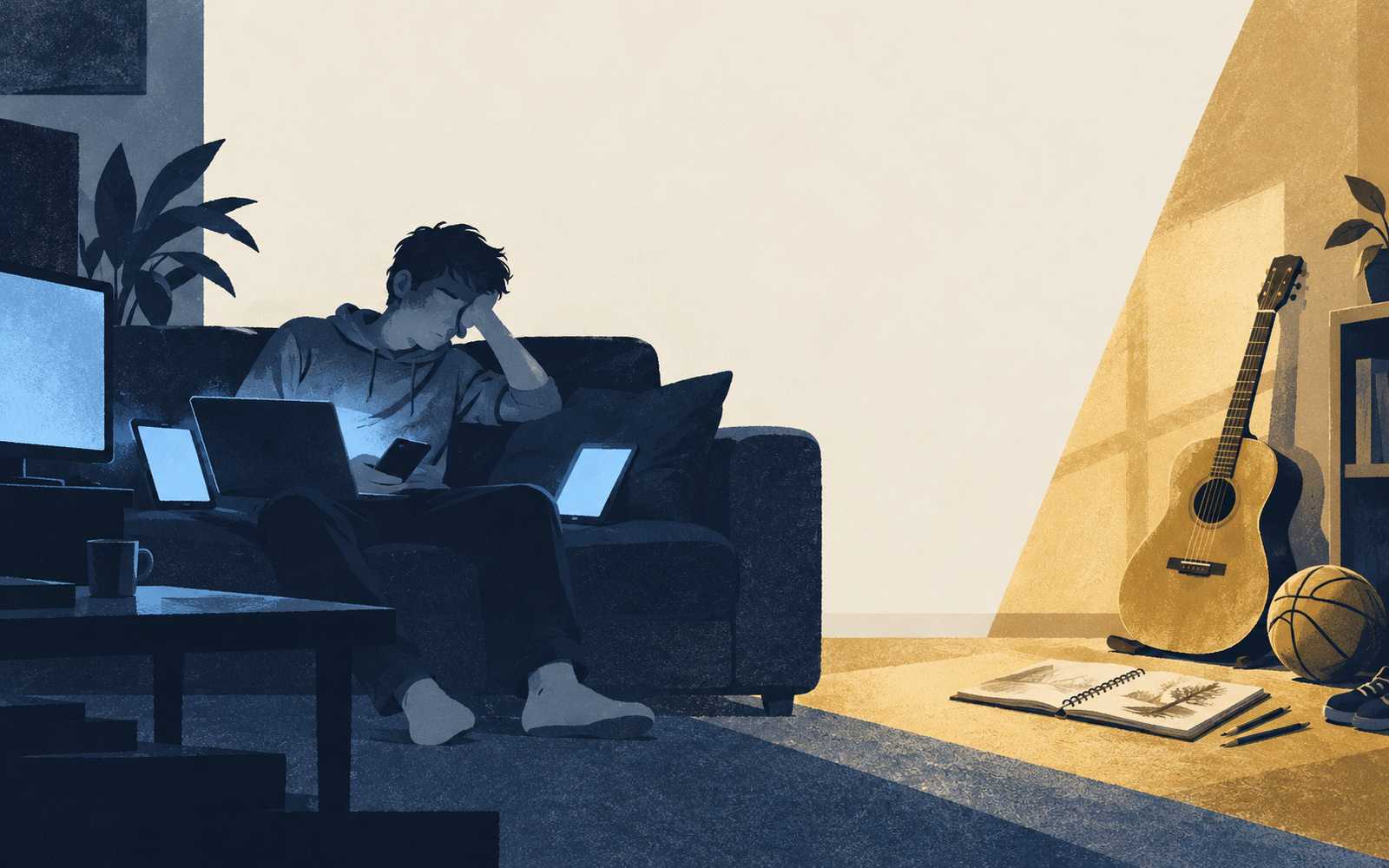
The other part of the answer is ownership. Teenagers rarely refuse to work hard at everything. More often they refuse to work hard on something that feels entirely borrowed. Many parents have seen a version of this: the teen who "won't try" in chemistry will spend an entire Saturday teaching themselves to edit video, fix a bike or learn every chord of a song. The effort was there all along. It just showed up where the work felt like theirs.
That is why I keep coming back to a simple question for teens: "Do I get to do it my way?" When the answer is always no, a lot of young people start editing themselves down to the minimum. They do what is asked, nothing more, and save the rest of who they are for places where it is welcome.
Trade the Pressure for a Reason They Can Feel
None of this means grades don't matter or that structure is the enemy. Teens need clear expectations. But inside those expectations, a few shifts may help more than another speech about the future.
Shrink the horizon. "Colleges will see this" is years away and abstract. "Let's see if you can get the first five problems right before dinner" is close enough to feel.
Connect the work to something they already care about. A teen who loves basketball may not care about statistics until you hand them their own shooting numbers.
Give them a real choice in how the work gets done, even a small one. Order of tasks, where they study, which book to report on. Choice is often where effort starts.
Look at the room before you look at the kid. Ask who your teen sits with, what is normal in that class and whether anyone there notices effort. Sometimes the most useful conversation is with a teacher, not your teen.
And notice where your teen already works hard without being told. That is not a distraction from school. It is information about who they are and what pulls effort out of them. As I argued in Raise the Individual, Not the Resume, the goal is not a teen who performs well under pressure. It is a young person who knows what is worth their best.
The research here is small and early, and I want to treat it that way. But it gives parents permission to stop shouting louder about stakes and start getting curious about meaning. Effort tends to arrive when the work starts to feel like theirs.
Research cited
Insel, C., Kastman, E. K., Glenn, C. R., et al. (2017). Development of corticostriatal connectivity constrains goal-directed behavior during adolescence. Nature Communications.
Lessard, L. M., & Juvonen, J. (2020). Engagement norms buffer academic risks associated with peer rejection in middle school. International Journal of Behavioral Development.
Want to explore these ideas further? Learn more about my work on leadership, identity and conviction at www.theglennllopis.com.
Effort grows when the work starts to feel like theirs, and no amount of pressure can make it theirs for them.
© 2026 Glenn Llopis Group, LLC. All rights reserved.
This article is the original work of Glenn Llopis and is protected by copyright. It may not be republished, reproduced, distributed or adapted, in whole or in part, in print, online or by AI tools, without prior written consent. You are welcome to share the link or quote a brief excerpt with credit to Glenn Llopis and a link back to this page. For permission requests, contact solutions@glennllopisgroup.com.
Get the next essay in your inbox
New essays on leadership, identity and conviction, sent to you when they publish. Free, and you can unsubscribe anytime.
Thank you. You're subscribed to Conviction Chronicles.
Something went wrong. Please try again.